Contents · 7 sections
Freundstein Castle stands on a rock overlooking the Route des Crêtes, between the Col Amic and the farm inn of the same name, in the municipality of Goldbach-Altenbach. The Châteaux forts d’Alsace association describes it as the highest castle in Alsace: sources put it at between 925 and 948 m above sea level.
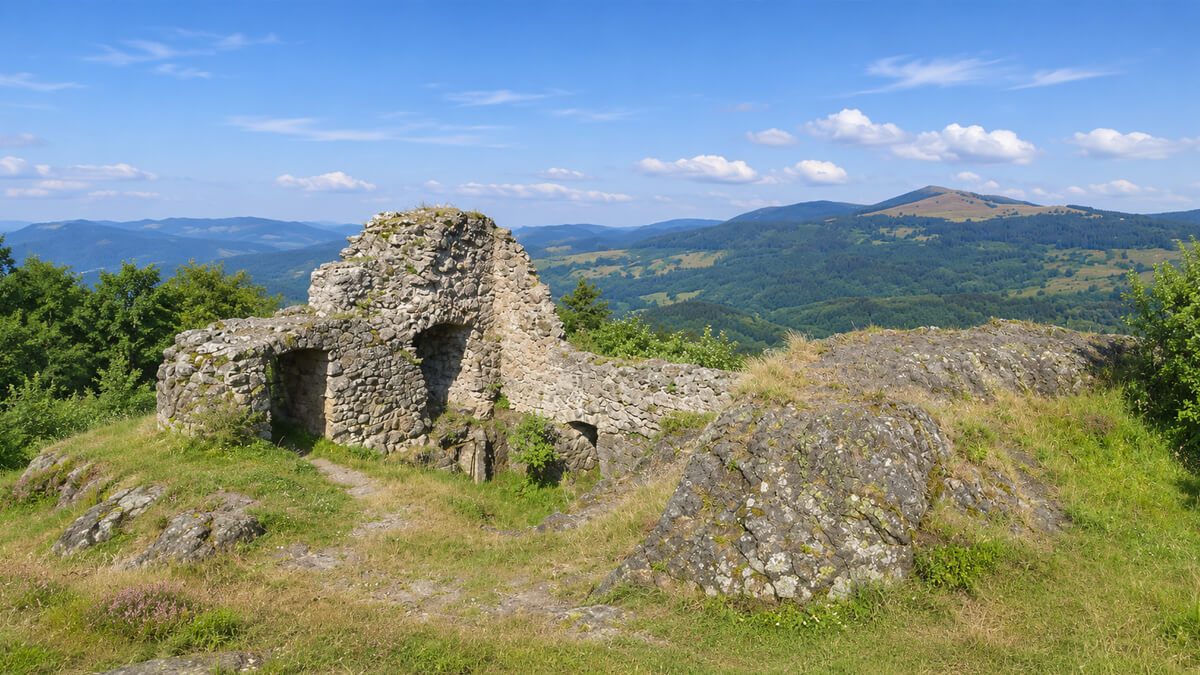
Only sections of wall and defences cut into the rock remain, but the site is worth it for its history and setting. Built by the lords of Waldner on the boundary between the lands of Murbach Abbey and the Bishopric of Strasbourg, it was used as an observation post by the French army in 1915, facing the Hartmannswillerkopf. The ruin is privately owned and freely accessible.
At a glance
- Where: Goldbach-Altenbach (Haut-Rhin), beside the Route des Crêtes, between the Col Amic and the Hartmannswillerkopf
- Altitude: around 925 to 948 m depending on the source
- Access: on foot from the Col Amic along the GR5, then a short waymarked detour to the rock
- Price: free, open access
- Time needed: 1 to 1.5 hours from the Col Amic, including the visit
- Who it’s for: hikers, First World War history enthusiasts, families with children who enjoy walking
- Status: private property (Waldner family), ruins listed as a historic monument in 1922
- Opening hours
- Open access all year round in daylight; the Route des Crêtes is partly closed in winter
- Location
- Route des Crêtes (D431), between the Col Amic and the Ferme-Auberge du Freundstein, 68760 Goldbach-Altenbach, Goldbach-Altenbach
- Price
- Free, open access
- Getting there
- From the Col Amic (road up from Willer-sur-Thur), follow the GR5 (red rectangle) towards Freundstein, then a short side path marked with a red rectangle crossed in white up to the ruin. Parking also in front of the Ferme-Auberge du Freundstein.
- Time needed
- 1 to 1.5 hours from the Col Amic, including the visit; 4 h 50 min for the loop from Willer-sur-Thur
- Accessibility
- Mountain path with a steep final climb onto the rock: not suitable for wheelchairs or pushchairs
Checked on October 26, 2026
Compare hotels for your dates before they fill up.
View on ExpediaPartner links.
Why visit Freundstein Castle?
- The highest castle in Alsace, according to the Châteaux forts d’Alsace association.
- A ridge-top panorama towards the Grand Ballon and the neighbouring valleys.
- Two stories in one place: a medieval castle and a First World War observation post.
- An easy stop to add to a trip along the Route des Crêtes or to the Hartmannswillerkopf.
- A farm inn nearby, open during the Route des Crêtes season.
The history of Freundstein Castle, from the Waldners to the Great War
Freundstein is the castle of the Waldners, a family of ministeriales charged with watching over the forests of the powerful Murbach Abbey. They built it on the border between the abbey’s lands and those of the Bishopric of Strasbourg, and acknowledged themselves vassals of both by ceding half of the castle to each, which they then received back as a fief.
- Late 13th century · the castle is built of greywacke rubble stone with granite frames.
- 1297 · first mention, in a deed of partition sealed by the lords of Waldner.
- 1441 · a lord zu Rhein imprisons two butchers from Mulhouse there with the Waldners’ consent; the town besieges the castle to free them.
- 1490 · another siege, this time by the troops of the Bishopric of Strasbourg, in conflict with the Waldners.
- 1525 · during the Peasants’ War, the insurgents set fire to the castle, which is then rebuilt.
- 1562 · destroyed by lightning, it is abandoned.
- 1570 · a drawing kept in the Haut-Rhin departmental archives shows the residence as a tower house.
- 1915 · the French army sets up an observation post in the ruin, facing the Hartmannswillerkopf; it is shelled several times.
- 1922 · the ruins are listed as a historic monument (27 April).
Military works in 1915–1918 heavily altered the ruin: a plan drawn up in 1920 shows a shelter for the observers and two observation posts, one facing the Hartmannswillerkopf, the other facing Soultz. Part of what you see today therefore dates from the war, not the Middle Ages.
 via GetYourGuideGuided tours in Goldbach-AltenbachPrices and dates on the partner siteBook
 via GetYourGuideDay trips from Goldbach-AltenbachPrices and dates on the partner siteBook
Partner links: if you book through these links, Alsace Voyage earns a commission at no extra cost to you.
What to see at Freundstein Castle
The ruin is modest. Allow about twenty minutes to walk around it, longer if you want to enjoy the view.
The walls of the upper castle
Sections of wall survive from the quadrangular residence, pierced by loopholes and later openings. The south-west façade retains two niched arrow slits whose firing slots have disappeared.
The rock and the outer bailey
Defences cut into the rock and a ditch separate the likely site of the outer bailey from the lord’s residence. The outer bailey has not been studied by archaeologists.
Traces of 1915
The fittings of the French observation post blend into the medieval masonry. Looking east, you can see why the army was interested in the rock: the Hartmannswillerkopf is very close.
The panorama
From the platform, the view opens onto the Grand Ballon and the neighbouring valleys. The final climb is steep for about ten metres.
 Read nextWasenbourg Castle
How to get to Freundstein Castle
The castle sits a few dozen metres above the Route des Crêtes (D431). The easiest starting point is the Col Amic, at 828 m.
By car: from the Col Amic
The Col Amic is reached by the road that climbs from Willer-sur-Thur in the Thur valley; this access normally stays open all year. Via Uffholtz, near Cernay, the Route des Crêtes towards the Hartmannswillerkopf is closed in winter.
- Park at the Col Amic, where the road from Willer-sur-Thur meets the Route des Crêtes.
- Head south on the GR5, marked with the Club Vosgien’s red rectangle, towards Freundstein: about 1.1 km to the Col du Freundstein.
- At the pass, take the side path marked with a red rectangle crossed in white that climbs to the ruin, then return the same way.
From the Ferme-Auberge du Freundstein
There is a car park on the Route des Crêtes in front of the Ferme-Auberge du Freundstein (municipality of Willer-sur-Thur), a little south of the ruin. The farm inn is only open during the Route des Crêtes season, from mid-April to mid-November.
Without a car: from Willer-sur-Thur
Willer-sur-Thur is served by the Thur valley railway line (Mulhouse–Kruth). A 13 km loop with 650 m of ascent climbs to the Col Amic following the yellow ring, passes the ruin and the farm inn, then comes back down through the Wissbach valley: allow 4 h 50 min.
Our walk: from Willer-sur-Thur to Freundstein
For experienced walkers, a 13 km loop (about 4 h 50 min, 650 m of ascent), waymarked and maintained by the Club Vosgien de Thann (IGN map 3620 ET).
Start · Willer-sur-Thur
After the bridge at the edge of the village, follow the Wissbach for about a hundred metres, then take the yellow ring.
Stage 2 · The Col Amic
The climb through the forest comes out on the Route des Crêtes. Take the GR5, together with the yellow ring, towards Freundstein.
Stage 3 · Freundstein Castle
Take the detour up to the rock, then continue to the Ferme-Auberge du Freundstein.
Finish · The Wissbach valley
Head back down to Willer following the yellow ring; a detour of about 1 km leads to the Ferme-Auberge de l’Ostein, open all year according to the route guide.
Our tips for your visit
- Wear good shoes: the last stretch up onto the rock is steep.
- The ruins are fragile and there are sheer drops: do not climb on the walls and keep children close.
- Before setting off in winter, check whether the Route des Crêtes is open and what the snow conditions are.
- The site is exposed: bring warm clothing, even in summer, and water.
Top tip Combine the ruin with the nearby Hartmannswillerkopf along the Route des Crêtes: from Freundstein you can see the summit that the French observers were watching in 1915.
Things to do around Freundstein Castle
Freundstein makes a stop along the Route des Crêtes, between the Grand Ballon and the Hartmannswillerkopf.
Our picks around Freundstein
- The Hartmannswillerkopf (Vieil-Armand) · a First World War battlefield with a crypt and military cemetery; according to the Châteaux forts d’Alsace association, there is an admission charge.
- The Grand Ballon · the highest point in the Vosges, further north along the Route des Crêtes.
- The Ferme-Auberge du Freundstein · beside the Route des Crêtes, open from mid-April to mid-November.
- The Freundstein chapel · a small chapel at 930 m on the Molkenrain loop, which starts from the farm inn.
- Thann · the town of the Saint-Thiébaut collegiate church, where the Thur valley opens out.
Our verdict
Freundstein is not a spectacular ruin, but it is one of the few castles in Alsace you can reach almost straight from the Route des Crêtes. Its strength is its position: a ridge-top rock on the border between two lordships, turned into an observation post in 1915.
We recommend it as a stop on a day out along the ridges, from late spring to autumn, when the road is open and the farm inn is serving. Walkers will prefer the loop from Willer-sur-Thur, longer but more rewarding.
— The Alsace Voyage team
Freundstein Castle: frequently asked questions
Is Freundstein Castle the highest castle in Alsace?
That is what the Châteaux forts d’Alsace association states, giving it an altitude of 948 m. Other sources say around 925 to 930 m, which places it among the highest in any case.
Do you have to pay to visit Freundstein Castle?
No. The ruins belong to the Waldner family but are open to all free of charge, at visitors’ own risk.
Where can I park for Freundstein Castle?
At the Col Amic on the Route des Crêtes, or in the car park in front of the Ferme-Auberge du Freundstein. From there, the ruin is reached on foot via the GR5 and a short waymarked detour.
Which municipality is Freundstein Castle in?
In the municipality of Goldbach-Altenbach (Haut-Rhin), close to the boundary with Willer-sur-Thur.
Can you go there in winter?
The Route des Crêtes is partly closed in winter; access to the Col Amic from Willer-sur-Thur normally stays open. Check the snow conditions before you set off.
Why was Freundstein used during the First World War?
Its rock faces the Hartmannswillerkopf. The French army set up an observation post there from 1915 onwards, which was shelled several times by the German army.
Sources: Base Mérimée (French Ministry of Culture) – Châteaux forts d’Alsace (chateauxfortsalsace.com) – Club Vosgien de Thann – Wikipedia (Château de Freundstein)
Hello ! My name is Clémence, and I’m a true lover of Alsatian culture and its ancestral traditions. Ever since my childhood spent strolling through Christmas markets and decorating bredeles, I’ve been fascinated by the authenticity of our beautiful region. Today, I share my passion for traditional costumes, local festivals, and Alsatian legends through my articles. What do I love most? Meeting artisans, tasting a new kougelhopf recipe, or discovering a forgotten little chapel. I hope my stories inspire you to dive into the festive and warm soul of Alsace.
 CastlesWasigenstein Castle