Contents · 7 sections
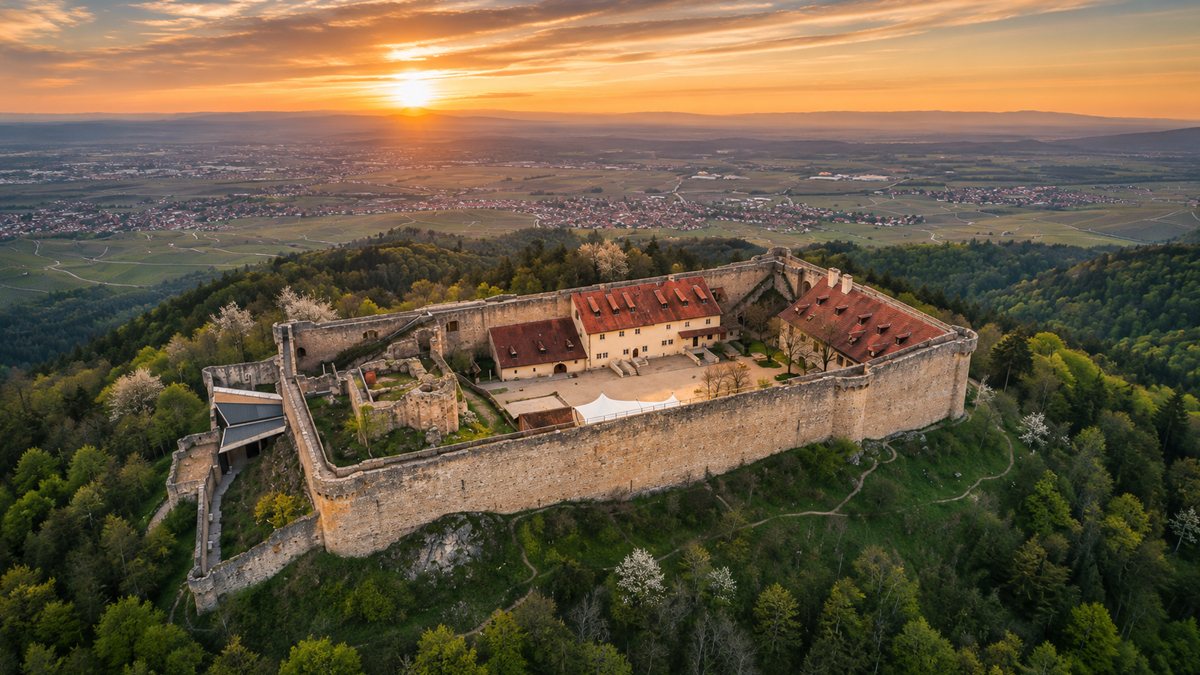
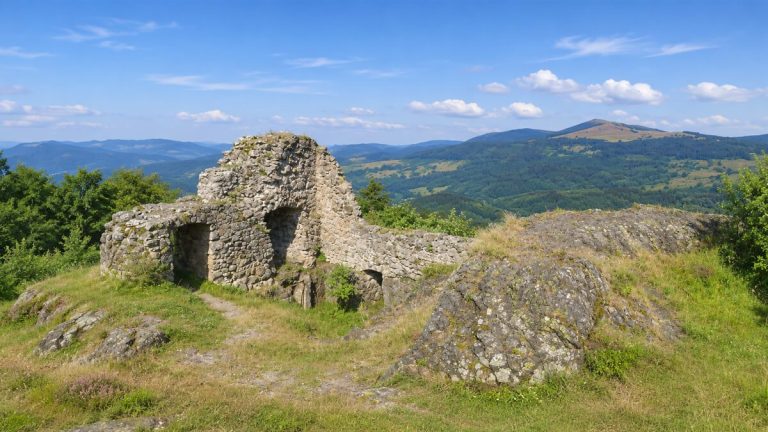
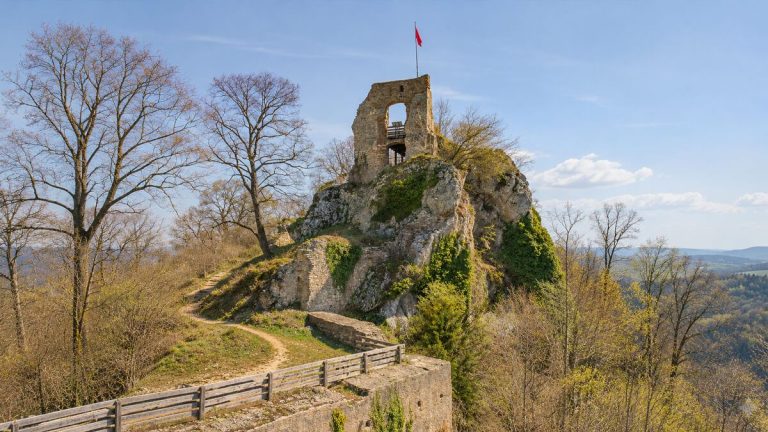
Hohnack Castle crowns the summit of the Petit Hohnack, at an altitude of 927 m, above the village of Labaroche. Only Freundstein, at 948 m, stands higher in Alsace. Built in the 12th century and adapted to firearms at the end of the Middle Ages, it was the main fortress of the lords of Ribeaupierre before being dismantled on the orders of Louis XIV in 1655.
The ruins are free and can be reached in a fifteen-minute walk. Note that, according to the tourist offices, entry inside the curtain wall is prohibited. You therefore discover the castle from the outside, walking around its artillery ramparts, with wide views over the Munster and Kaysersberg valleys.
At a glance
- Where: Labaroche (Haut-Rhin), about 12 km west of Colmar and 6 km from Turckheim as the crow flies
- Altitude: 927 m, on the summit of the Petit Hohnack (the tourist offices give 940 m)
- Access: a fifteen-minute walk from the La Trinque car park; 5 km loop from the centre of Labaroche
- Price: free, outer grounds open access all year round
- What you see: the curtain wall, its artillery towers and the view; the inside of the walls is off-limits
- Time needed: 45 min from La Trinque; 2 hours for the loop from Labaroche
- Who it’s for: families with children who enjoy walking, hikers, lovers of panoramic views
- Status: listed historic monument since 19 August 1905, owned by the municipality of Labaroche
- Opening hours
- Outer grounds open access all year round in daylight (unstaffed site). According to the tourist offices, entry inside the curtain wall is prohibited.
- Location
- Summit of the Petit Hohnack, above the village of Labaroche (68910); nearest car park at the hamlet of La Trinque, Labaroche
- Price
- Free
- Getting there
- Car park at the hamlet of La Trinque, then about 600 m of forest path (yellow trestle waymark), a fifteen-minute climb. 5 km loop from the Musée des Métiers du bois (woodcraft museum) in Labaroche. 13 km circuit from Orbey.
- Time needed
- About 45 min from La Trinque, including a walk around the ramparts; 2 hours for the loop from the centre of Labaroche
- Accessibility
- Sloping forest path: not suitable for wheelchairs or pushchairs
Checked on October 26, 2026
Compare hotels for your dates before they fill up.
View on ExpediaPartner links.
Why visit Hohnack Castle?
- The second-highest castle in Alsace: only Freundstein, at 948 m, is higher.
- A fortress adapted to cannon: the late 15th-century curtain wall, with its square towers and semicircular tower, shows how a 12th-century castle was transformed to face firearms.
- Walls of rusticated stone, blocks whose outer face is left rough and bulging, and masons’ marks left by the stonecutters.
- A viewpoint over the Vosges: the view stretches across the Munster and Kaysersberg valleys and, on clear days, as far as the Alsace plain.
- A short, free outing, easy to extend with a loop through the meadows of Labaroche.
The history of Hohnack Castle, from the Counts of Ferrette to Louis XIV
Hohnack belonged to the Counts of Ferrette, then to the lords of Ribeaupierre, who made it their most important fortress. Its position between the Kaysersberg and Munster valleys explains why it was fought over until the Thirty Years’ War.
- 1079 · a chronicle written much later names the castle as a possession of the Counts of Eguisheim; this mention is considered doubtful.
- 12th century · a curtain wall and a square keep are built; a Hohnack family holds the castle as a fief of the Counts of Ferrette.
- 1251 · the Counts of Ferrette make the castle a fief of the Bishop of Strasbourg.
- 1288 · the Ribeaupierres, who had disputed its ownership, now become its owners.
- 1361 · the Ribeaupierres hand it over as a dowry to the lords of Sarrewerden; it later passes to the Lupfen family.
- 1437–1438 · the castle returns for good to the Ribeaupierres, who enlarge it.
- Late 15th century · the curtain wall is rebuilt for firearms: square bastions, a semicircular tower and a barbican in front of the gate.
- 1635 · during the Thirty Years’ War, a French garrison seizes it at the instigation of the governor of Colmar.
- 1655 · Louis XIV orders the castle to be dismantled.
- Revolution · the ruins are sold as national property; they are used as a stone quarry until 1898.
- 1886 · the de Golbéry family donates the ruin to the Society for the Conservation of Historic Monuments of Alsace.
- 1905 · the ruins are listed as a historic monument by decree of 19 August.
Today, the ruin belongs to the municipality of Labaroche and the Compagnons du Hohnack association looks after its upkeep and events. A survey carried out in 2020 led to plans to make the north-east curtain wall, the gate tower and the residence safe, with support from the Collectivité européenne d’Alsace. The site welcomed around 10,000 visitors in 2022.
The name is thought to come from the German Hohen Acker, “the upper field”. Bombards, the earliest cannon, dating from the late 14th or early 15th century, have been found on the site.
 via GetYourGuideGuided tours in LabarochePrices and dates on the partner siteBook
 via GetYourGuideDay trips from LabarochePrices and dates on the partner siteBook
Partner links: if you book through these links, Alsace Voyage earns a commission at no extra cost to you.
What to see at Hohnack Castle
As the inside of the walls is closed to the public, you visit from the outside, at the foot of the walls. Follow the signs on site and do not go past closed entrances.
The artillery curtain wall
At the end of the 15th century, the oval 12th-century curtain wall was replaced by an eight-sided wall flanked by towers able to hold firearms. It is the most imposing part of the ruin, and the one you follow as you walk around the summit.
The four towers
They bear names handed down by tradition: the gate tower to the east, preceded by a barbican (an outwork protecting the gate), the witches’ tower to the west, the mill tower to the north-west and, to the south, the chapel tower, a semicircular artillery tower.
The keep and the residence
In the middle of the courtyard stands a section about 8 m high of the square 12th-century keep, built on its own without touching the curtain wall. The lord’s residence leaned against the east side of the rampart; a well and a cistern supplied the garrison with water. These remains lie inside the walls.
The rusticated stones
In the 12th as in the 15th century, the builders used rusticated stones, whose outer face is left rough and projecting. On the remodelled ramparts you can also spot masons’ marks, the signs carved by stonecutters to identify their work.
The panorama
From the summit of the Petit Hohnack, the view opens onto the Munster and Kaysersberg valleys and, in clear weather, as far as the Alsace plain.
 Read nextWasenbourg Castle
How to get to Hohnack Castle
The castle lies in the municipality of Labaroche, a village spread out over the heights between the Kaysersberg and Munster valleys. Signposts in the village point the way to the site.
By car: La Trinque car park (a fifteen-minute walk)
This is the shortest route: the car park at the hamlet of La Trinque, at 838 m, lies at the foot of the Petit Hohnack.
- From Colmar, drive via Turckheim, climb to Trois-Épis on the D11 and continue to Labaroche.
- In the village, follow the signs for the castle to the hamlet of La Trinque and park in the car park.
- Take the path marked with a yellow trestle that climbs through the forest: about 600 m and 90 m of ascent to the ruins.
- Walk around the outside of the curtain wall, then come back down the same way.
On foot from the centre of Labaroche (5 km loop)
An easy 5.1 km loop starts from the Musée des Métiers du bois, in the hamlet of La Place. It climbs along small roads and through meadows to La Trinque, then follows the yellow trestle to the castle. Allow 2 hours and 193 m of ascent. The full route is described below, in our walk.
From Orbey: the tourist office circuit (13 km)
The Kaysersberg valley tourist office suggests a 13 km hike between Orbey and Labaroche, which crosses the meadows and climbs up to the ruins. Allow about 3 h 30 min and nearly 600 m of ascent; the woodcraft museum is halfway along.
Without a car
The castle is hard to reach without a car: the nearest railway station is 18 km away, according to the tourist office. Check coach connections before setting off.
Our walk: the Petit Hohnack loop from Labaroche
To make the most of the meadows and viewpoints of Labaroche, start from the village centre rather than the La Trinque car park. The loop is 5.1 km long with 193 m of ascent: allow 2 hours, including a stop at the castle.
Start · The Musée des Métiers du bois
Park at the hamlet of La Place, at 743 m, in front of the museum. Walk a few metres along the D11.1, then take the path marked with a yellow cross.
Stage 2 · The meadows of La Trinque
The route crosses the D11 junction and climbs along small roads between meadows to the hamlet of La Trinque, at 838 m. Take care when crossing roads.
Stage 3 · The climb to the castle
At La Trinque, turn right onto the yellow trestle: the path enters the forest and climbs steadily for just over 500 m to the ruins, at 924 m.
Finish · The Hohnack ruins
Walk around the outside of the curtain wall and enjoy the view. The return descends on the green ring through a Scots pine forest, then follows the blue trestle back to the start.
Our tips for your visit
- Wear good walking shoes: the last climb through the forest is fairly steep.
- Do not go past closed entrances: the inside of the walls is off-limits and the masonry is fragile.
- Above 900 m it is often cooler than on the plain: bring a warm layer, even in summer.
- There is no water and there are no toilets at the castle: bring something to drink.
- In winter, snow is common at this altitude: check the state of the paths before setting off.
Top tip Choose a clear day in spring or autumn: the view from the Petit Hohnack then reaches as far as the Alsace plain. Every two years in June, the Compagnons du Hohnack hold a medieval festival at the castle: keep an eye on the Labaroche events programme.
Things to do around Hohnack Castle
Hohnack is easy to combine with a day in the Kaysersberg valley or a tour of the castles of Alsace around Colmar.
Our picks around Hohnack
- The Musée des Métiers du bois · the woodcraft museum in Labaroche, where the Petit Hohnack loop begins.
- Turckheim · a small fortified town at the foot of the vineyards, at the entrance to the Munster valley.
- Kaysersberg Castle · its round keep overlooks the old town and the Weiss valley.
- Hohlandsbourg Castle · a restored fortress above Wintzenheim with a wall walk, open from April to early November.
- The three castles of Eguisheim · three pink sandstone keeps above Husseren-les-Châteaux, freely accessible.
- Orbey Christmas market · in December, in the neighbouring village.
Our verdict
Hohnack suits walkers who love high-altitude ruins and sweeping landscapes. The climb from La Trinque is short, and the loop from Labaroche adds lovely open meadows looking out over the Vosges.
Before you go, be aware that the inside of the walls is closed: you come for the scale of the artillery ramparts, the rusticated stones and the view, not to wander around the courtyard. We recommend it in spring and autumn, in clear weather, when the view reaches furthest.
— The Alsace Voyage team
Hohnack Castle: frequently asked questions
Do you have to pay to visit Hohnack Castle?
No. The grounds around the ruins are open to all free of charge all year round. According to the tourist offices, however, entry inside the curtain wall is prohibited.
How high is Hohnack Castle?
The ruins stand at 927 m, on the summit of the Petit Hohnack; the tourist offices give 940 m. It is the second-highest castle in Alsace after Freundstein.
How long does it take to walk up to Hohnack?
About fifteen minutes from the car park at the hamlet of La Trinque, in Labaroche. The loop from the village centre is 5 km long and takes about 2 hours.
Can you go there with children?
Yes, with children who are used to walking: the climb is short but fairly steep. Keep them close at the foot of the walls, which are fragile.
Is the castle accessible by wheelchair or pushchair?
No. The last stretch is a sloping forest path.
Which castles can you see near Hohnack?
Kaysersberg Castle, Hohlandsbourg above Wintzenheim and the three castles of Eguisheim can all be reached by car in a day.
Sources: Base Mérimée (French Ministry of Culture) – Wikipedia (Château du Hohnack) – Collectivité européenne d’Alsace – Kaysersberg Valley Tourist Office – Visorando
Hello ! My name is Clémence, and I’m a true lover of Alsatian culture and its ancestral traditions. Ever since my childhood spent strolling through Christmas markets and decorating bredeles, I’ve been fascinated by the authenticity of our beautiful region. Today, I share my passion for traditional costumes, local festivals, and Alsatian legends through my articles. What do I love most? Meeting artisans, tasting a new kougelhopf recipe, or discovering a forgotten little chapel. I hope my stories inspire you to dive into the festive and warm soul of Alsace.
 CastlesFerrette Castle
 CastlesWasigenstein Castle