Contents · 7 sections
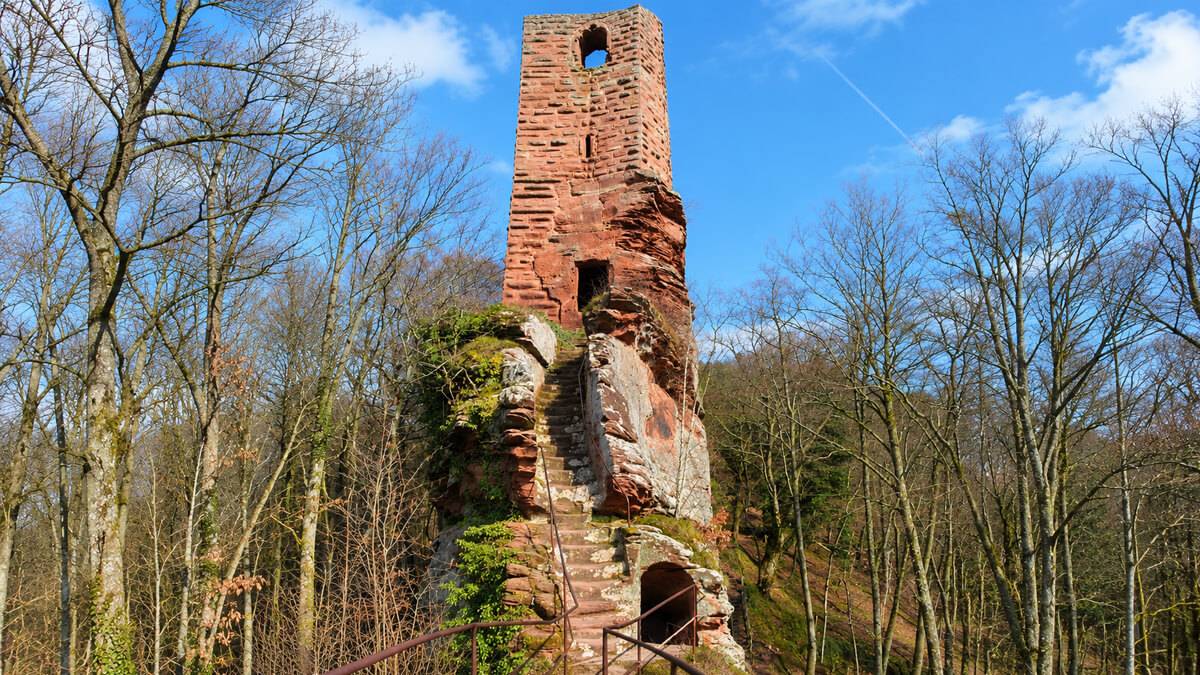
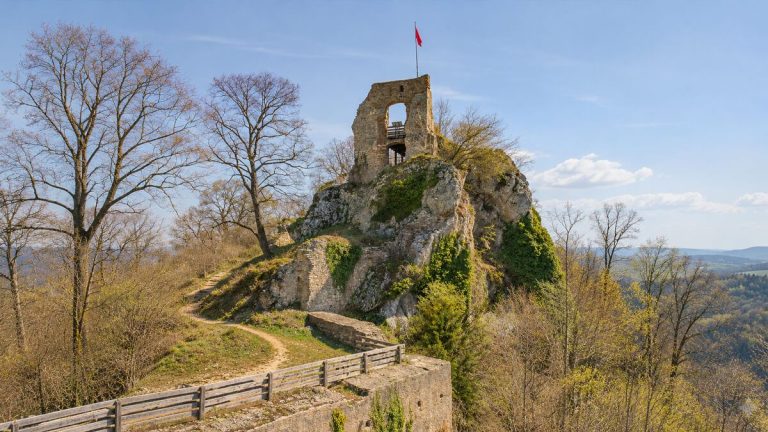
Wasigenstein Castle is a twin castle: two neighbouring fortresses, Great and Little Wasigenstein, built in the 13th century on two sandstone rocks separated by a narrow cleft, above Niedersteinbach, about 350 m from the German border. Tradition places here the fight of Walter of Aquitaine, hero of a 10th-century Latin poem.
Please note: access to the castle is prohibited until further notice, “because of the dangerous access to the building”, according to the Alsace Verte tourist office (updated August 2026). The waymarked GR 53 trail leads to its surroundings: you can look at the rocks and their walls without entering the ruins or climbing the rocks. Check the situation before you set off.
Key facts at a glance
- Where: Niedersteinbach (Bas-Rhin), Steinbach valley, near the German border
- Altitude: about 340 m
- Opening: access to the ruins prohibited until further notice (tourist office, August 2026)
- Access: Klingelfels car park (D190), then 15 minutes on a waymarked trail (red rectangle, GR 53) to the surroundings
- What remains: two rocks bearing a pentagonal keep, a shield wall, living quarters and cisterns, to be viewed from nearby
- Price: free, unstaffed site
- Who it’s for: hikers and history lovers, staying on the trail
- Status: historic monument listed in 1898, owned by the French State
- Opening hours
- Access to the castle prohibited until further notice (Alsace Verte tourist office, updated August 2026)
- Location
- D190, 67510 Niedersteinbach; Klingelfels car park, towards Wengelsbach, Niedersteinbach
- Price
- Free (unstaffed site)
- Getting there
- Klingelfels car park (D190), then 15 minutes on a trail waymarked with a red rectangle (GR 53) to the surroundings of the castle
- Time needed
- 30 minutes there and back from the car park; 2½ hours for the Steinbach rocks loop
- Accessibility
- Forest path: not suitable for wheelchairs or pushchairs
Checked on October 26, 2026
Compare hotels for your dates before they fill up.
View on ExpediaOur guide: where to stay in NiedersteinbachPartner links.
What makes Wasigenstein special
- A twin castle: two branches of the same family built two fortresses side by side, on two rocks.
- The setting of an epic: tradition places Walter’s fight against King Gunther’s knights in the cleft between the rocks.
- Remarkable architecture: a pentagonal keep, a shield wall nearly 5 m thick and a Gothic window with tracery.
- A walk among the Steinbach rocks, where you also pass the Klingelfels and the Bohemians’ Rock.
The history of Wasigenstein Castle
The castle takes its name from the rock it stands on, the Wasigenstein. Shared from the end of the 13th century between two branches of the Wasigenstein family, then among some fifteen co-owners, it was besieged many times.
- Before 1270 · construction of Great Wasigenstein, on the eastern rock, by the brothers Seman and Friedrich, or before 1257 by their father Engelhard, according to the historian Thomas Biller.
- 1270 · first mention: the two brothers call themselves “of Wasichenstein” in a deed in favour of Marienthal Abbey.
- Before 1299 · another branch of the family builds Little Wasigenstein on the western rock; deeds of 1299 and 1306 settle the division.
- Around 1306 · new entrances, a widened moat and a flanking tower to the south-east of the outer bailey.
- Mid-14th century · the Wasigenstein family dies out; its shares pass notably to the Fleckenstein and Hohenbourg families.
- Around 1450 · Great Wasigenstein has twelve co-owners, Little Wasigenstein three.
- 1385–1468 · repeated sieges: 1385, 1410, 1447 and 1464 for Little Wasigenstein, 1468 for Great Wasigenstein.
- 16th century · the castle is probably abandoned.
- 17th century · the ruins suffer during the Thirty Years’ War; German Wikipedia also mentions destruction by General de Montclar’s troops in 1680.
- 1711 · the Fleckenstein family sells its rights to the Hanau-Lichtenberg family.
- 1898 · the ruins are listed as a historic monument.
In the 19th century, the German poet Joseph Victor von Scheffel devoted a poem to the ruin, already famous for its link with the legend of Walter.
 via GetYourGuideGuided tours in NiedersteinbachPrices and dates on the partner siteBook
 via GetYourGuideDay trips from NiedersteinbachPrices and dates on the partner siteBook
Partner links: if you book through these links, Alsace Voyage earns a commission at no extra cost to you.
What remains of Wasigenstein
The ruins are closed to the public. The description below, taken from the heritage inventory, helps you understand what you can see from nearby.
Great Wasigenstein
On the eastern rock, about 20 m high and 75 m long, stand a pentagonal keep, preserved to a height of some ten metres, and a shield wall about 4.80 m thick facing the mountain. There are also the remains of living quarters with a chapel, a cistern, a former guardroom and a spiral staircase.
Little Wasigenstein
On the western rock, large living quarters follow the shape of the rock, with twin windows and an early Gothic window with tracery. A residential tower houses a filtration cistern, and its door was defended by an arrow slit cut into the rock.
Walter’s Cleft and the outer bailey
Between the two rocks, a narrow cleft is known as “Walter’s Cleft”. The outer bailey, in rusticated sandstone, had an entrance to the east, with a room hollowed out of the rock, and a gate to the west closed by a drawbridge.
The Klingelfels and the Bohemians’ Rock
Nearby, the Klingelfels, a rock with no remains, may have served as a lookout post. The Zigeunerfels, or Bohemians’ Rock, carried a small castle in the 14th and 15th centuries; its name is said to come from bandits who occupied it in the 17th century.
Walter of Aquitaine at Wasigenstein
The Waltharius, a 10th-century Latin poem, tells how Walter of Aquitaine, caught up in the Vosges forest by King Gunther, entrenches himself between two rocks, in a passage so narrow that his opponents must face him one at a time. He defeats eleven of them.
Tradition places this fight in the Wasigenstein cleft. Yet the Latin text does not name the place: it speaks of a forest called Vosagus and of two nearby mountains between which a narrow cave opens. Some authors even place the scene on the nearby Maimont.
 Read nextWasenbourg Castle
How to get close to Wasigenstein
As long as the ban is in force, you do not enter the ruins. The routes below reach the surroundings along waymarked trails; follow the signs on site.
By car: Klingelfels car park (15 minutes on foot)
This is the access recommended by the Alsace Verte tourist office and the Northern Vosges Regional Nature Park.
- In Niedersteinbach, take the D3 towards Obersteinbach.
- Turn onto the D190 towards the hamlet of Wengelsbach and park at the Klingelfels car park.
- Follow the red rectangle of the GR 53 on foot: about 15 minutes to the castle.
- Stop nearby: access to the ruins and rocks is prohibited.
On foot from Niedersteinbach or Obersteinbach
Several waymarked loops pass near the castle: “Au détour des rochers du Steinbach” from Niedersteinbach (see our walk), or “Entre la vallée du Steinbach et Wengelsbach” from Obersteinbach (10.5 km, 3½ hours, red rectangle then red diamond). The castle is also on the second stage of the Alsace Castles Trail, from the Litschhof pass to Obersteinbach.
Without a car
We could not find a regular bus line serving Niedersteinbach. The nearest stations are Niederbronn-les-Bains and Wissembourg.
Our walk: around the Steinbach rocks
This Alsace Verte tourist office loop starts from Niedersteinbach: 7.5 km, 291 m of ascent, about 2½ hours. It links several sandstone rocks in the valley and passes Wasigenstein; while the ban lasts, stay on the trail.
Start · Niedersteinbach
The village in the Steinbach valley, at the foot of the sandstone rocks.
Stage 2 · The Almenfels and the Bohemians’ Rock
The trail enters the forest and runs along the rocks; the Bohemians’ Rock carried a small castle at the end of the Middle Ages.
Stage 3 · The Klingelfels
The rock that gives the car park its name, perhaps a former lookout post of the castle.
Finish · Wasigenstein
The two rocks of the twin castle, to be viewed from the trail, before heading back to Niedersteinbach.
Our tips
- Respect the access ban: the ruins are considered dangerous and the rocks are some twenty metres high.
- Before you go, contact the Alsace Verte tourist office in Niederbronn-les-Bains (03 88 80 89 70), which publishes closures of sites and trails in the area.
- Walking shoes recommended: the forest trails are slippery after rain.
- Bring water: there are no facilities on site.
Top tip Round off the walk with the Maison des châteaux forts in Obersteinbach (42 rue Principale): photos, maps and objects found in the valley’s ruins help you picture the inside of the castles that can no longer be visited. Check its opening hours before you go.
Things to do around Wasigenstein
Niedersteinbach lies at the heart of the Northern Vosges Regional Nature Park. The GR 53, described in our article on the first stage from Wissembourg to Obersteinbach, links the castles of the valley.
Our picks around Wasigenstein
- Niedersteinbach · the nearest village, at the foot of the rocks.
- The Maison des châteaux forts in Obersteinbach · a small museum devoted to the castles of the Northern Vosges, with a garden and maze.
- Petit-Arnsbourg Castle · a semi-troglodyte castle above Obersteinbach, freely accessible, a 30-minute walk from the village.
- Froensbourg Castle · another ruin in the valley, closed to visitors since 2022.
- Fleckenstein Castle · the large castle in the area that is set up for visitors, open to the public, north of Lembach.
Our editors’ verdict
Wasigenstein has everything to leave an impression: twin fortresses, a pentagonal keep, a massive shield wall and the legend of Walter. The closure announced in 2026 keeps visitors out for now, and you should not try to get around it.
Until it reopens, we recommend it as the goal of a walk in the Steinbach valley, staying on the trail, combined with nearby Petit-Arnsbourg, which is freely accessible.
— The Alsace Voyage editorial team
Frequently asked questions about Wasigenstein Castle
Can you visit Wasigenstein Castle?
Not at the moment. The Alsace Verte tourist office states that access to the castle is prohibited until further notice because of the dangerous access (updated August 2026). Check before you set off.
Where to park for Wasigenstein?
At the Klingelfels car park, on the D190 between Niedersteinbach and Wengelsbach. The waymarked GR 53 trail (red rectangle) leads to the castle’s surroundings in 15 minutes.
Why are there two castles?
Great Wasigenstein, on the eastern rock, is recorded from 1270; Little Wasigenstein, on the western rock, was built before 1299 by another branch of the family. The two fortresses had different owners.
Is Wasigenstein the setting of the legend of Walter?
Tradition places here the fight of Walter of Aquitaine against King Gunther’s knights, told in the Latin poem Waltharius. The text does not name the place: the identification remains a tradition.
Which castles can you see near Wasigenstein?
Petit-Arnsbourg, above Obersteinbach, is freely accessible; Fleckenstein, near Lembach, is open with a ticket. Froensbourg and Lutzelhardt are also closed to visitors.
Sources: Office de tourisme de l’Alsace Verte – Inventaire général du patrimoine culturel (Grand Est Region) – Base Mérimée (French Ministry of Culture) – Wikipedia (Wasigenstein Castle) – chateauxfortsalsace.com
Hello ! My name is Clémence, and I’m a true lover of Alsatian culture and its ancestral traditions. Ever since my childhood spent strolling through Christmas markets and decorating bredeles, I’ve been fascinated by the authenticity of our beautiful region. Today, I share my passion for traditional costumes, local festivals, and Alsatian legends through my articles. What do I love most? Meeting artisans, tasting a new kougelhopf recipe, or discovering a forgotten little chapel. I hope my stories inspire you to dive into the festive and warm soul of Alsace.
 CastlesFerrette Castle