Contents · 6 sections
Ferrette Castle crowns the small town of the same name, in the heart of the Alsatian Jura, about 25 km from Basel and 35 km from Mulhouse. It is one of the oldest castles in Alsace and the cradle of the Counts of Ferrette, a dynasty that ruled southern Alsace for two centuries. Two parts remain: the upper castle, with its residential tower partly carved into the rock, and the lower castle, bristling with artillery towers.
The site is free to visit all year round. A ten-minute climb from the town is enough, and the platform of the upper castle offers a wide panorama over the Vosges, the Black Forest and the Jura. The walk is easy to combine with the nearby Dwarves’ Cave (Grotte des Nains).
Key facts at a glance
- Where: Ferrette (Haut-Rhin), in the Alsatian Jura, about 25 km from Basel and 35 km from Mulhouse
- Altitude: about 610 m, on a rocky spur above the town
- Access: tourist office or former courthouse car park, then a 10-minute walk
- Price: free, open access all year round
- Time needed: 45 to 60 minutes to visit, plus a 10-minute climb
- Who it’s for: families (baby carrier rather than pushchair), history lovers; dogs on a lead allowed
- On site: audio points in three languages via QR code, printed guide from the tourist office
- Status: historic monument listed on 16 February 1930; privately owned, under a long-term lease to the town
- Opening hours
- Open access all year round; guided tours available on request from the Sundgau tourist office
- Location
- Rue du Château, 68480 Ferrette (tourist office car park, 3A route de Lucelle, or opposite the former courthouse), Ferrette
- Price
- Free. Printed guide “À la découverte des châteaux du Jura alsacien” on sale at the tourist office (€3)
- Getting there
- Tourist office car park (3A route de Lucelle) or opposite the former courthouse (Rue du Château), then a 10-minute walk; or Charles-de-Gaulle car park, opposite the church, and the Club vosgien blue-triangle trail (10 minutes).
- Time needed
- 45 to 60 minutes to visit, plus a 10-minute climb
- Accessibility
- Stony, uneven and fairly steep path: pushchairs not recommended (use a baby carrier), no wheelchair access
Checked on October 26, 2026
Compare hotels for your dates before they fill up.
View on ExpediaPartner links.
Why visit Ferrette Castle?
- The cradle of a great dynasty: the Counts of Ferrette dominated southern Alsace before handing over to the Habsburgs in 1324.
- A tower carved into the rock: the residential tower of the upper castle, hollowed out of the limestone, is one of the first of its kind in Alsace.
- A panorama over three mountain ranges: the Vosges, the Black Forest and the Jura from the summit platform.
- A short, free visit, with audio commentary to listen to on site.
- A full outing: the castle, the Dwarves’ Cave and the Rossberg viewpoint combine on a loop of about 6 km.
The history of Ferrette Castle, from the counts to the princes of Monaco
Founded by a branch of the Counts of Montbéliard, the castle was the seat of a powerful county, then of an Austrian bailiwick, before being ruined by the Thirty Years’ War and the Revolution.
- 1105 · first mention of the castle according to the tourist office and the town (other sources give 1100 or 1144).
- Around 1125 · Frederick, son of Count Thierry I of Montbéliard, settles at the castle and takes the title of Count of Ferrette.
- 1271 · Count Ulrich II sells the castle and the lordship to the bishop of Basel, who grants them back to him as a fief.
- 1324 · the marriage of Joan of Ferrette to Albert II of Habsburg brings the county to Austria; the castle becomes the residence of a bailiff.
- 1469 · Sigismund of Austria pledges his Alsatian lands to Charles the Bold; Peter von Hagenbach becomes their governor.
- 16th century · the Fuggers, bankers from Augsburg, have a rampart built linking the upper and lower castles; the archdukes adapt the stronghold to firearms.
- 1632–1635 · the Swedes take the castle; rebel peasants drive out their garrison in 1634, then French troops burn and ruin the upper castle in 1635.
- 1659 · Louis XIV gives the lordship of Ferrette to Cardinal Mazarin; the castle gradually falls into ruin.
- 1777 · through marriage, the title of Count of Ferrette passes to the princes of Monaco, who still hold it.
- 29 July 1789 · during the Great Fear, insurgents from the Saint-Amarin valley loot and burn the lower castle, which is then used as a quarry.
- 1930 · the ruins are listed as a historic monument (16 February).
- 1998–2014 · volunteers from the Chantiers histoire et architecture médiévales association take part in the restoration.
The novelist Walter Scott featured the castle and the abuses of Peter von Hagenbach in Anne of Geierstein (1829). Now privately owned, the ruin is maintained thanks to a long-term lease held by the town of Ferrette, with support from the département and state services.
 via GetYourGuideGuided tours in FerrettePrices and dates on the partner siteBook
 via GetYourGuideDay trips from FerrettePrices and dates on the partner siteBook
Partner links: if you book through these links, Alsace Voyage earns a commission at no extra cost to you.
What to see at Ferrette Castle
The visit follows the slope: you first pass through the lower castle, then climb to the upper castle and its platform. Audio points, accessible via QR code in three languages, describe the main stops.
The upper castle
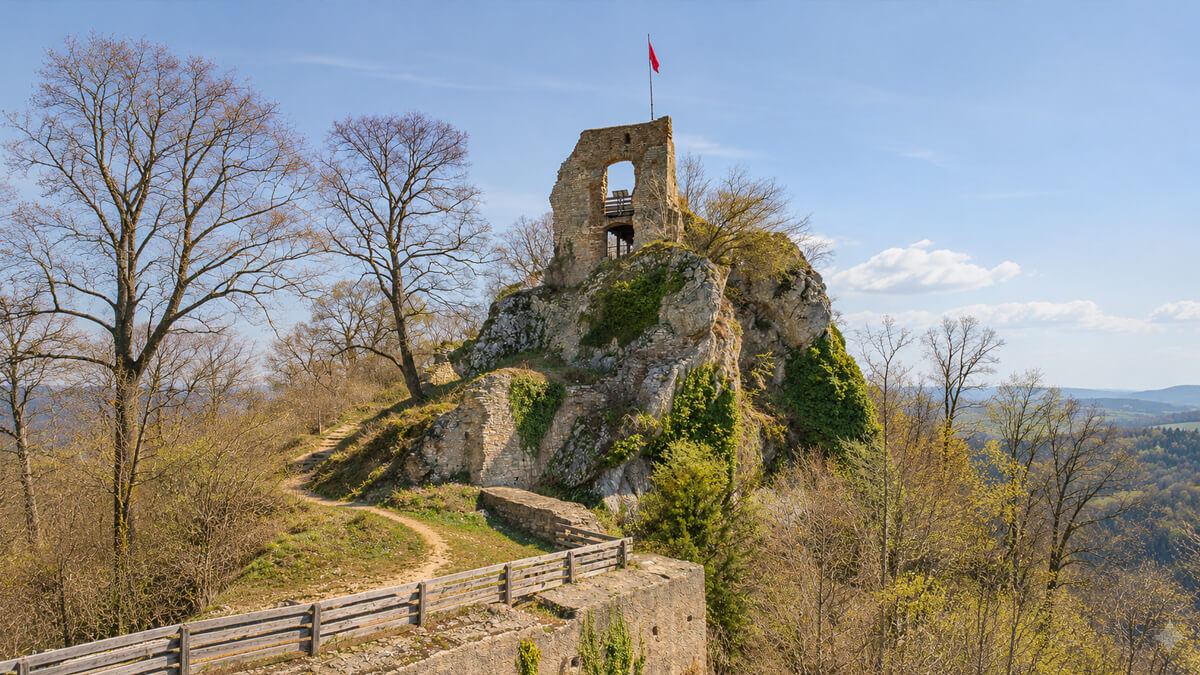
This is the oldest part. Its residential tower, carved into the limestone over several levels, is one of the first of its kind in Alsace. An access ramp for horses was cut into the rock. At the top, the platform opens onto a panorama over the Vosges, the Black Forest and the Jura.
The lower castle and its artillery towers
Further down, the lower castle lines up several round towers, open at the back and pierced with gun ports for cannon fire. You can also see a 16th-century gateway and a bastion fitted with a gun embrasure.
The Fugger rampart
In the 16th century, the Fuggers had the two castles linked by a rampart: the fortress then formed a single complex, adapted to firearms.
The chapel and the well
The site retains the remains of a chapel dedicated to Saint Catherine, rebuilt around 1660, and a 16th-century well; a description from 1600 gives it a depth of 60 m.
 Read nextWasenbourg Castle
How to get to Ferrette Castle
By car: tourist office or former courthouse car park (10-minute walk)
This is the easiest access: the dirt track climbs straight up to the ruins.
- Park at the tourist office car park, 3A route de Lucelle, or opposite the former courthouse, Rue du Château.
- Follow the waymarked path up to the castle: allow 10 minutes, the climb is short but fairly steep.
On foot from the church (10 minutes)
From the Charles-de-Gaulle car park, opposite the church, follow the Club vosgien blue triangle: the path passes the Lourdes grotto before reaching the ruins in about ten minutes.
Without a car
The railway line from Altkirch to Ferrette has been closed to passengers since 1951: ask the Sundgau tourist office about coach connections before you set off.
Our tips for your visit
- Wear good shoes: the access path is stony and uneven.
- Bring a baby carrier rather than a pushchair.
- Keep a close eye on children and do not climb on the walls: the ruins have been consolidated but remain fragile.
- Dogs are allowed on a lead.
- Bring your phone to listen to the audio points on site.
Top tip Drop in at the tourist office before you climb up: the little guide “À la découverte des châteaux du Jura alsacien” (€3) will help you link Ferrette, Morimont and Landskron in a full day of castles in the Sundgau.
Things to do around Ferrette Castle
Ferrette is the ideal starting point for discovering the castles of Alsace in the Alsatian Jura and its caves.
Our picks around Ferrette
- The Dwarves’ Cave · reached from the same starting point as the castle, on a waymarked loop of about 6 km.
- The Rossberg viewpoint · another viewpoint, on the same loop of about 6 km suggested by the tourist office.
- Morimont Castle · in Oberlarg, a Renaissance ruin with a 51 m-long vaulted cellar.
- Landskron Castle · in Leymen, on the Swiss border, with views over three countries.
- Dr Herring’s Cave · in Bendorf, another curiosity of the Alsatian Jura.
Our editors’ verdict
Ferrette Castle will appeal to those who like to understand a ruin: the tower carved into the rock, the artillery towers and the Fugger rampart tell six centuries of military evolution in an hour’s visit. The audio commentary on site is a great help.
We recommend it for families with children who are good walkers, and on a clear day to enjoy the panorama. The best plan is to make it the centrepiece of a half-day, together with the Dwarves’ Cave and the Rossberg.
— The Alsace Voyage editorial team
Frequently asked questions about Ferrette Castle
Is there an entrance fee for Ferrette Castle?
No. The castle is free to visit all year round, on your own. A small printed guide is on sale at the tourist office (€3).
How long does it take to visit the castle?
Allow a 10-minute climb from the car park and 45 to 60 minutes for the visit.
Where to park for Ferrette Castle?
At the tourist office car park (3A route de Lucelle), opposite the former courthouse (Rue du Château) or at the Charles-de-Gaulle car park, opposite the church.
Can you visit the castle with a pushchair or a dog?
A pushchair is not recommended: the path is stony and steep, so a baby carrier is better. Dogs are allowed on a lead.
Are there guided tours?
Yes, guided tours are offered from time to time or on request from the Sundgau tourist office. Audio points in three languages are also available on site.
Which castles can you see near Ferrette?
Morimont Castle in Oberlarg and Landskron Castle in Leymen complete the “three castles of the Alsatian Jura”.
Sources: Base Mérimée (French Ministry of Culture) – Office de tourisme du Sundgau – Châteaux forts d’Alsace – Wikipedia (Château de Ferrette, Ferrette)
Hello ! My name is Clémence, and I’m a true lover of Alsatian culture and its ancestral traditions. Ever since my childhood spent strolling through Christmas markets and decorating bredeles, I’ve been fascinated by the authenticity of our beautiful region. Today, I share my passion for traditional costumes, local festivals, and Alsatian legends through my articles. What do I love most? Meeting artisans, tasting a new kougelhopf recipe, or discovering a forgotten little chapel. I hope my stories inspire you to dive into the festive and warm soul of Alsace.
 CastlesWasigenstein Castle