

Contents · 5 sections
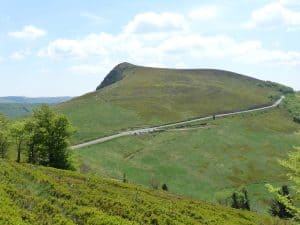
On the border between Alsace and Lorraine, Donon (1,009 m) towers over the northern Vosges. Its distinctive silhouette, crowned by a small colonnaded temple, can be spotted from afar. This sandstone mountain has been a place of worship since Antiquity, which is how it earned its nickname of sacred mountain. Here is what you need to know before setting off to explore it.
At a glance
- Location
- Grandfontaine
Where to stay in Grandfontaine
Compare hotels for your dates before they fill up.
View on ExpediaPartner links.
Where is Donon?
Donon rises in the Bas-Rhin, between Schirmeck (in the Bruche valley) and Sarrebourg, right on the edge of Lorraine. At 1,009 m (some maps say 1,008 m), it is the highest point of the sandstone Vosges, the northern part of the range. It is not, however, the highest summit of the Vosges (the Grand Ballon reaches 1,424 m), nor the highest point of the Bas-Rhin, a title held by the Champ du Feu (1,099 m).
The road over the Col du Donon (around 727 m) brings you close to the summit. On the Lorraine side, the massif is the source of the two branches of the Sarre: the Sarre Blanche and the Sarre Rouge, which meet further downstream to form the river.
A sacred mountain since Antiquity
The name Donon is thought to come from the Celtic dun, meaning both a height and a fortified place. Humans have occupied the site for a very long time, and the summit was used as a place of worship by the Gauls before becoming, in Gallo-Roman times, a sanctuary dedicated to Mercury, the most revered god in the region.
Excavations have uncovered votive steles and sculptures, including depictions of Mercury and of the god Vosegus, the guardian deity of the mountain who gave his name to the Vosges. Many of these remains are now kept in museums, notably the Archaeological Museum of Strasbourg, which displays the finds from Donon’s Gallo-Roman sanctuaries.
Book an activity in Grandfontaine
All activities via GetYourGuideGuided tours in GrandfontainePrices and dates on the partner siteBook
 via GetYourGuideDay trips from GrandfontainePrices and dates on the partner siteBook
Partner links: if you book through these links, Alsace Voyage earns a commission at no extra cost to you.
The summit temple: a 19th-century pastiche
The small colonnaded temple crowning the summit is not ancient. It was built in 1869, under Napoleon III, by the architect Louis-Michel Boltz, to serve as a museum housing the carved stones found on site. Those pieces have since been moved to museums, but the building remains the emblem of Donon and the goal of most hikers.
After the war of 1870–1871, the new Franco-German border set by the Treaty of Frankfurt ran across Donon: until 1918, the mountain thus remained a landmark between annexed Alsace and France.
 Read nextThe Route des Crêtes in the Vosges: a magnificent route to discover
Hiking to the top of Donon
The most popular ascent starts from the Col du Donon area. The trail, waymarked by the Club Vosgien, climbs through the forest, fairly steeply at first and then in switchbacks, passes close to a rock shelter and comes out onto the summit rocks. Allow a little under an hour to get up. A classic loop of about 5 km with 265 m of elevation gain takes around 2 hours 15 minutes, breaks included.
- At the summit: the temple, carved steles, information panels and a viewpoint indicator.
- The view: on a clear day, it stretches over the Vosges ridges, the Lorraine plateau and, to the east, the Alsace plain.
- What to bring: sturdy shoes (rocks and roots) and a windproof jacket, even in summer, as the summit is exposed.
- Best season: May to October. Autumn, with its golden beech woods, is especially beautiful. In winter, the trail may be snowy or icy.
Our tips for your visit
Set aside half a day for the climb, time to enjoy the summit and the walk down. To round off your discovery, combine the hike with the Bruche valley on the Alsace side, or with a visit to the Archaeological Museum of Strasbourg, where you can see the steles from Donon. For your safety, stay on the waymarked trails and respect the remains: this fragile archaeological site has been handed down for almost two thousand years.

Enzo
Hi, I'm Enzo! I'm the guy who loves lacing up his hiking boots to explore the rugged trails of the Vosges. Passionate about nature and photography, I take you along through articles that capture the scent of fir forests and the charm of mountain lakes. I live for those moments when the sun rises over the Haut-Koenigsbourg or when I stumble upon an authentic inn along the way. My goal? To inspire you to get out, breathe in the fresh Alsatian air, and always have a great spot for a tarte flambée to share at the end of the day.
 Vosges & Great ValleysExplorer breathtaking natural landscapes to escape