
Contents · 6 sections
At a glance
- Built in the 13th century on a former estate of Andlau Abbey
- Remarkable remains: Romanesque keep, Renaissance living quarters, chapel tower
- Free access all year round, pets allowed and a picnic area available
- Summer programme: guided tours, talks, shows
- Fragile site: care and respect recommended
A medieval fortress set in the Vosges forest
Round a bend in a woodland path, the ruins of the Château de Wangenbourg suddenly appear on their rocky outcrop. Its silhouette weathered by the ages, this fortress built in the 13th century still bears the scars of its eventful history. A massive keep, crumbling ramparts and Renaissance living quarters bear witness to the past ambitions of the lords of Wangen, who built this strategic stronghold.
Records mention the castle as early as 1295, standing within a vast monastic estate. Its territorial importance is obvious: the fortification rises close to the Obersteigen–Dabo road, a major trade and military route at the time.

Book an activity in Wangenbourg-Engenthal
All activities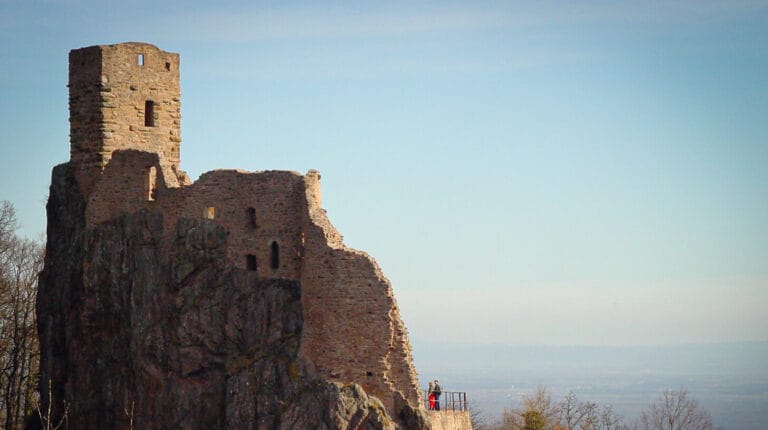 via GetYourGuideGuided tours in Wangenbourg-EngenthalPrices and dates on the partner siteBook
 via GetYourGuideDay trips from Wangenbourg-EngenthalPrices and dates on the partner siteBook
Partner links: if you book through these links, Alsace Voyage earns a commission at no extra cost to you.
Architecture shaped by the centuries
From Romanesque foundations to Renaissance alterations
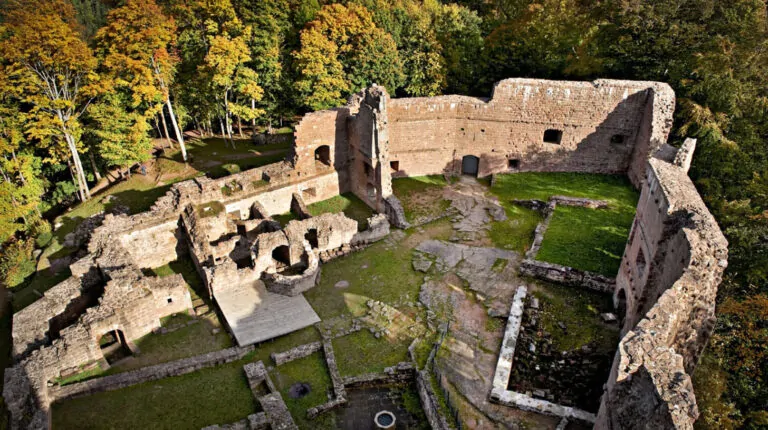
The visit begins with the remains of an early keep, probably dating from before 1250. Its foundations can still be seen in the central courtyard, along with the remains of a filtration cistern, proof of a residence built to last.
Later, the two residential buildings added in the 16th century brought a Renaissance touch to this military complex. The chapel tower, partly destroyed by a French garrison in the 17th century, closes off the northern wall. This dynamited section of wall illustrates the fate of many abandoned castles under Louis XIV.
An outer bailey facing the valley
To the east, the outer bailey opens onto a clear view and is a favourite picnic stop for walkers. The remains here are more scattered, but the spot works its charm through the seasons, from carpets of leaves in autumn to lush ferns in summer.
 Read nextKolbsheim Castle and its Gardens
The castle of the Wangen family: quarrels and rebuilding
Records reveal family and religious disputes over the fortress. From the 14th century onwards, the Wangen family split into two branches, each claiming its share of the estate. Through lack of maintenance, the building had partly fallen into ruin by the early 16th century.
Between 1518 and 1523, restoration work co-financed by the Bishopric of Strasbourg breathed new life into the site. But tensions did not ease: financial disputes with Bishop Johann von Manderscheid once again plunged the castle into uncertainty. In the end, the French military presence in the 17th century put a definitive end to its strategic use.
A free visit in the heart of the “Switzerland of Alsace”
Just a ten-minute walk from the village of Wangenbourg, the site is freely accessible all year round. Close by, hitching rails for horses and a picnic area offer a pleasant stop for riders and walkers.
Tips for a safe visit
As the Château de Wangenbourg is partly in ruins, you are strongly advised to take care:
- keep away from unstable low walls
- keep an eye on children
- do not climb the walls
- do not damage the stonework
Pets are allowed on the site, provided they are kept on a lead.
Practical information
- Admission: free
- Address: Site de Wangenbourg, 67710 Wangenbourg-Engenthal
- Telephone: +33 (0)3 88 87 33 50
- Access: from the village centre, follow the waymarked path heading south-east
A cultural stop in the Mossig valley
Off the main tourist trails, the Château de Wangenbourg appeals to lovers of history and heritage. Every summer, the site comes alive with guided tours, historical shows and open-air talks, held in the idyllic setting of its outer bailey.
A true medieval interlude in the Alsatian countryside, this slumbering fortress continues to tell its legends to anyone who takes the time to listen.

Clémence
Hello ! My name is Clémence, and I’m a true lover of Alsatian culture and its ancestral traditions. Ever since my childhood spent strolling through Christmas markets and decorating bredeles, I’ve been fascinated by the authenticity of our beautiful region. Today, I share my passion for traditional costumes, local festivals, and Alsatian legends through my articles. What do I love most? Meeting artisans, tasting a new kougelhopf recipe, or discovering a forgotten little chapel. I hope my stories inspire you to dive into the festive and warm soul of Alsace.
 CastlesRathsamhausen Castle