Contents · 3 sections
If you love history, hiking or sweeping views, the castles of Alsace are made for you. Several dozen medieval fortresses, from romantic ruins to restored castles, dot the Vosges from the north of the Bas-Rhin to the area around Colmar. Here is our selection of 12 castles not to be missed.
Alsace is one of the regions of France richest in medieval castles. Most were built between the 12th and 14th centuries on the ridges and rocky spurs of the Vosges, to control the valleys, the roads and the Rhine plain. Many were ruined during the Thirty Years’ War or the wars of Louis XIV, then rediscovered in the 19th century by hikers and lovers of old stones.
Usually built of pink sandstone or granite, they can be visited in two ways today: a few restored castles with an entrance fee, a visitor reception and a set tour, and a large number of freely accessible ruins, reached on foot along the trails waymarked by the Club Vosgien.
At a glance
Where to stay in Alsace
Compare hotels for your dates before they fill up.
View on ExpediaPartner links.
The great restored castles
Haut-Koenigsbourg castle (Orschwiller)
Haut-Koenigsbourg is the most famous castle in Alsace and one of the most visited monuments in the region. Perched at around 750 m above Sélestat, it is first mentioned in the 12th century; it was burned during the Thirty Years’ War (1633), then given to Emperor Wilhelm II, who had it rebuilt by the architect Bodo Ebhardt in the early 20th century. Inside you will find furnished rooms, a collection of weapons, a medieval garden and, on a clear day, a vast view over the Alsace plain, the Black Forest and sometimes the Alps.
Fleckenstein castle (Lembach)
In the Northern Vosges, close to the German border, Fleckenstein is a spectacular example of a cave castle: some of its rooms and staircases are carved directly into a long sandstone rock. It dates back to the 12th century and was destroyed by French troops at the end of the 17th century. The ruin, laid out for visitors, is complemented by family activities and by the “four castles” walking trail, which links several neighbouring ruins on both sides of the border.
Lichtenberg castle
North of Ingwiller, Lichtenberg castle was the cradle of the powerful lords of Lichtenberg in the 13th century, before being turned into a fortress in the early modern period. Bombarded in 1870, it has been restored and now combines old stones with contemporary architecture. Its ramparts offer a fine view over the forests of the Northern Vosges.
Hohlandsbourg castle (Wintzenheim)
Above Wintzenheim, a few kilometres west of Colmar, Hohlandsbourg was built at the end of the 13th century by the Habsburgs. Its large restored curtain wall lets you walk the full circuit of the wall-walk, with open views over the vineyards, Colmar and the Rhine plain. The castle offers tours and events in season.
La Petite-Pierre castle
In the heart of the Northern Vosges Regional Nature Park, La Petite-Pierre castle overlooks a charming fortified village. Remodelled over the centuries, it now houses the Maison du Parc, with an exhibition space devoted to the landscapes and heritage of the Northern Vosges. The village is an excellent starting point for hikes.
The finest freely accessible ruins
Haut-Barr castle (Saverne)
Nicknamed “the eye of Alsace”, Haut-Barr stands on three sandstone rocks above Saverne. Built in the 12th century for the bishops of Strasbourg, it offers one of the most famous panoramas over the Alsace plain. Don’t miss the footbridge known as the “Devil’s Bridge”, which links two of the rocks, or the nearby Chappe telegraph tower.
Ortenbourg castle (Scherwiller)
A few kilometres from Sélestat, Ortenbourg dates from the 13th century and is recognisable by its tall, very well-preserved pentagonal granite keep. Just below it lies the ruin of Ramstein: the two castles can be visited together on a lovely forest walk from Scherwiller.
Spesbourg castle (Andlau)
Above Andlau, near Barr, Spesbourg is a 13th-century granite ruin, with a fine square keep and walls pierced by twin windows still standing. It is reached on foot through the forest, often combined with the neighbouring castle of Haut-Andlau.
The castles of Ribeauvillé
Three castles watch over Ribeauvillé: Saint-Ulrich, residence of the lords of Ribeaupierre, with its beautiful hall and Romanesque windows; Girsberg on its rocky pinnacle; and Haut-Ribeaupierre, the highest of the three. A walking loop from the town lets you discover all three.
The Three Castles of Eguisheim
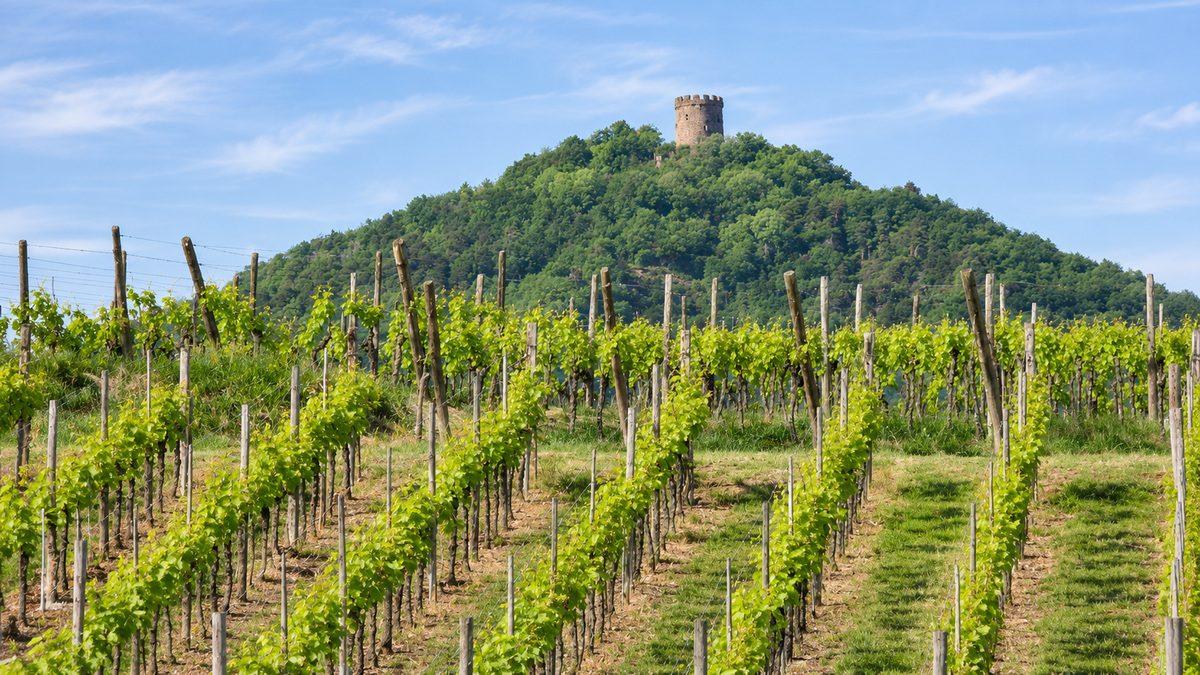
On the heights of Husseren-les-Châteaux, the three pink sandstone keeps of Weckmund, Wahlenbourg and Dagsbourg form a silhouette visible from far across the vineyards. A road and footpaths lead up to them from Eguisheim and Husseren.
Kaysersberg castle
Above the medieval town of Kaysersberg, Kaysersberg castle retains an imposing 13th-century round keep. The short but steep climb starts from the town centre and rewards you with a bird’s-eye view over the rooftops and vines.
Landsberg castle (Heiligenstein)
Near Mont Sainte-Odile, Landsberg is a 12th–13th-century ruin notable for its castle chapel and its residential wing with large windows. It is reached on foot through the forest, from Heiligenstein or Barr.
Book an activity in Alsace
All activities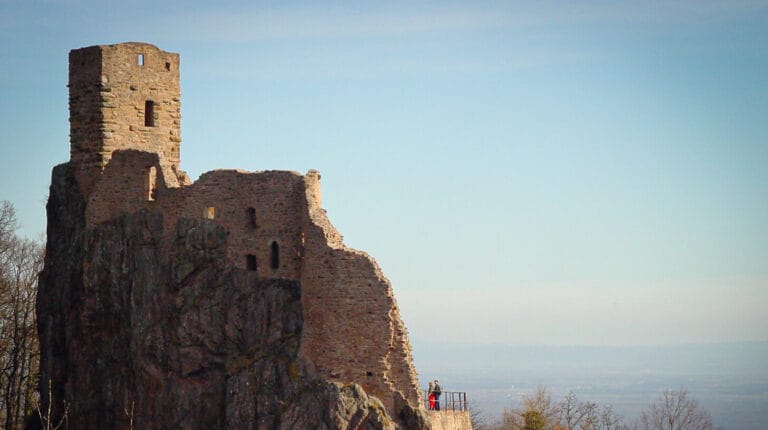 via GetYourGuideGuided tours in AlsacePrices and dates on the partner siteBook
 via GetYourGuideDay trips from StrasbourgPrices and dates on the partner siteBook
Partner links: if you book through these links, Alsace Voyage earns a commission at no extra cost to you.
Our tips for visiting the castles of Alsace
- Wear good shoes: most ruins are reached on foot, along sometimes steep paths, in 15 minutes to an hour’s walk.
- Follow the Club Vosgien waymarks and the Alsace castles trail (chemin des châteaux forts d’Alsace), which links many of the sites.
- The ruins are ancient sites: stay in the areas laid out for visitors and keep an eye on children near the drops.
- For the restored castles with an entrance fee (Haut-Koenigsbourg, Fleckenstein, Lichtenberg, Hohlandsbourg…), check their official website before setting off: opening times and seasons vary throughout the year.
- The best time to go is from spring to autumn; in October, the colourful forests make a superb setting.
From the Northern Vosges to the vineyards, the castles of Alsace tell a thousand years of history along beautiful hiking trails. To round off your stay, also discover the best things to do in Alsace.
 Read nextKolbsheim Castle and its Gardens
Émilie
Hello ! My name is Émilie, and I have a soft spot for stories that inspire dreams. From the legends of medieval castles to the mysteries of Alsatian forests and the tales of Great History, I take you on a journey through time. Passionate about writing and discovery, I spend my days exploring archives, listening to locals, and weaving this richness into my articles. I especially love writing about places where reality and imagination intertwine, like Mont Sainte-Odile or Christmas tales. So, are you ready for an extraordinary adventure ?
 CastlesRathsamhausen Castle