Contents · 7 sections
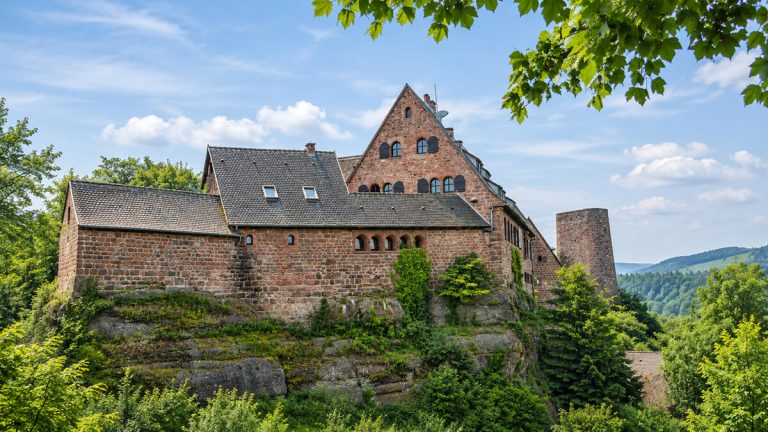
Loewenstein Castle, also known as Lindenschmidt, stands on two sandstone rocks within the boundaries of Wingen, a village in northern Alsace not to be confused with Wingen-sur-Moder. A neighbour of Hohenbourg, it was one of the castles guarding the old route over the Litschhof pass, between Bitche and Wissembourg.
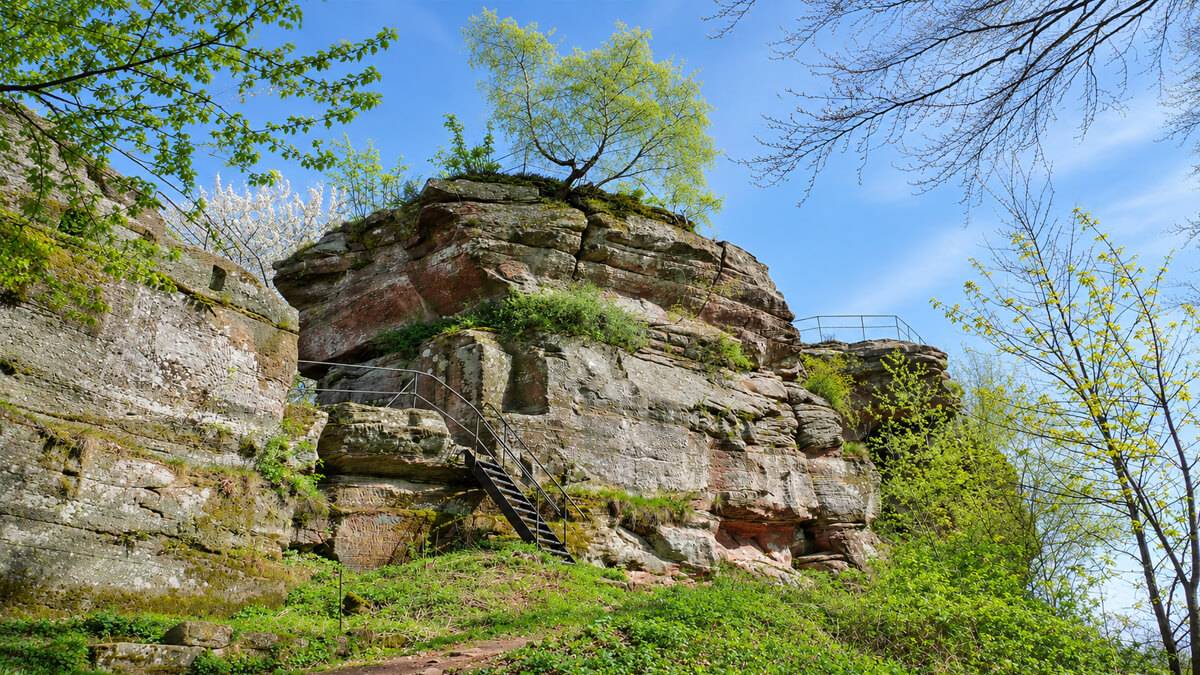
Few walls remain: the appeal of the site lies in the rock itself, hollowed out with stairways, passages and rooms, and in the view over the Palatinate and the Sauer valley. Access is free and open, half an hour’s walk from the Fleckenstein Castle car park.
Key facts at a glance
- Where: Wingen (Bas-Rhin), north of Lembach, a few hundred metres from Hohenbourg
- Altitude: between 520 and 530 m depending on the source
- Access: 30 to 45 minutes on foot from the Fleckenstein car park, via the Hohenbourg pass
- Price: free, open access all year round
- What remains: shaped rocks, carved stairways and rooms, a cistern, a few walls of rusticated stone
- Time needed: about 1 hour 30 minutes there and back from the car park, including the visit
- Who it’s for: hikers, families with children used to walking, fans of rock castles
- Status: historic monument listed in 1898, owned by the French State
- Opening hours
- Open access all year round, in daylight (forest site, unstaffed)
- Location
- Loewenstein rocks, above the Hohenbourg pass (Col du Hohenbourg); recommended start: Fleckenstein Castle car park (Lembach), Wingen
- Price
- Free
- Getting there
- Free Fleckenstein car park (Lembach), then 30 to 45 minutes on foot via the Hohenbourg pass (red rectangle of the GR 53 or red triangle, then red-white-red waymarks)
- Time needed
- About 1 hour 30 minutes there and back from the car park, including the visit
- Accessibility
- Forest path and rocks: not suitable for wheelchairs or pushchairs
Checked on October 26, 2026
Compare hotels for your dates before they fill up.
View on ExpediaPartner links.
Why visit Loewenstein Castle?
- A castle carved into the rock: stairways, passages and rooms cut into the sandstone show how people lived in a rock castle.
- Two rocks, two castles: the main castle to the east and the lower outer castle to the west, separated by a gorge.
- A tale of robber knights, which led to its destruction in 1386 and earned it the nickname Lindenschmidt.
- Open views over the Palatinate Forest and the Sauer valley.
- An easy stop on the four-castle circuit, best combined with neighbouring Hohenbourg.
The history of Loewenstein Castle, imperial castle and robbers’ den
An imperial castle in the 13th century, Loewenstein had a short life: shared between several lords, it became a den of robber knights and was destroyed as early as the end of the 14th century.
- 12th–13th century · construction of the castle, which seems to have belonged to the Fleckenstein family from the Hohenstaufen era.
- 13th century · first mention, as an imperial fief of Wolfram of Loewenstein.
- 1276 · after the siege of Fleckenstein, Rudolf of Habsburg takes over the castle.
- 1282–1283 · Rudolf entrusts it to the Ochsenstein family.
- 1380 · the castle is shared with Hensel Streif of Landenberg.
- 1383 · one half is pledged to Hanemann I of Zweibrücken-Bitsch.
- 1386 · accused of robbery, the castle is taken and destroyed by John of Lichtenberg.
- 1457 · repaired by the Puller family of Hohenbourg according to some sources, it falls to the Elector Palatine Frederick I, at war with Richard Puller.
- Late 15th century · deemed beyond repair, the castle is abandoned; in 1485 the ruin passes to the Counts of Zweibrücken-Bitsch.
- 1570 · the ruins pass to the Hanau-Lichtenberg family, then in 1736 to the House of Hesse-Darmstadt.
- 1670s · French troops under General de Montclar destroy what remains.
- 1898 · the ruins are listed as a historic monument.
Sources disagree on the castle’s end: Wikipedia considers that it was probably never rebuilt after 1386, whereas chateauxfortsalsace.com and burgenwelt.org say it was repaired by the Pullers as an outpost of Hohenbourg. The Mérimée database dates its destruction to 1387.
 via GetYourGuideGuided tours in WingenPrices and dates on the partner siteBook
 via GetYourGuideDay trips from WingenPrices and dates on the partner siteBook
Partner links: if you book through these links, Alsace Voyage earns a commission at no extra cost to you.
What to see at Loewenstein Castle
Masonry is scarce: people come mainly for the rocky ridge and its carved features. Allow about twenty minutes to walk around it.
The main castle
On the higher, eastern rock, there are the remains of a stair tower, a few walls of rusticated sandstone and stairways cut into the rock. These rusticated stones, with a rounded face and dressed edges, are common in Alsatian castles of the 12th and 13th centuries.
The outer castle and the gorge
Lower down, to the west, a second rock carried the outer castle. A gorge separates it from the main castle; a passage crosses the northern rock, and a cellar was dug into the rock next to the former moat.
The cistern
A cistern carved into the sandstone collected rainwater, essential for a hilltop castle with no spring. It is one of the best-preserved features of the site.
The viewpoint
From the top of the rock, the view opens onto the Palatinate Forest and the Sauer valley. The rock has sheer drops: take care, especially with children.
Lindenschmidt, the left-handed blacksmith
The castle’s second name, Lindenschmidt, appears on 19th-century German maps. According to chateauxfortsalsace.com, it comes from Linkenschmied, the “left-handed blacksmith”, the nickname of a bandit who shod his horses backwards to fool his pursuers.
Another tradition, reported without a source by Wikipedia, says that the knight, his son and his servant were captured, tried at Schönau in the Palatinate and hanged. The judge is said to have declared: “mitgegangen, mitgefangen, mitgehangen” (“came along, caught along, hanged along”).
 Read nextFroensbourg Castle
How to get to Loewenstein Castle
Loewenstein can only be reached on foot, along the same trails as Hohenbourg. The most convenient starting point is the free car park at Fleckenstein Castle, in Lembach.
By car: Fleckenstein car park (30 to 45 minutes on foot)
The four-castle circuit signpost gives about 45 minutes from Fleckenstein to the three ruins at the pass; Loewenstein is the first.
- From Lembach, take the D3 towards Bitche, then the D925 towards Schönau and the D525 to the Fleckenstein car park.
- Climb to the Hohenbourg pass (about 20 minutes) via the sunken lane of the GR 53 (red rectangle) or the rocks trail (red triangle), which is steeper and slippery in wet weather.
- At the pass, follow the red-white-red waymarks to Loewenstein.
- Hohenbourg is only a few minutes away: carry on along the same waymarks to see it.
From the Litschhof pass or the Gimbelhof
The Litschhof pass (335 m), on the border road, has a car park. It is the start of the second stage of the Alsace Castles Trail, on which Loewenstein is the first castle; it is about 500 m away as the crow flies, but nearly 200 m higher. The Gimbelhof farm, a hotel-restaurant reached by a forest road from Lembach, is another base, linked to the Hohenbourg pass by a trail waymarked with a red disc.
Without a car
No public transport serves the site. The Fluo 310 coach line stops in Lembach, about 5 km from the Fleckenstein car park; in previous years a seasonal shuttle ran from Wissembourg station, on reservation. Check before you set off.
Our walk: three border castles from Fleckenstein
Loewenstein is best discovered on the four-castle circuit: about 10 km, 200 m of ascent and 3 to 4 hours of walking from the Fleckenstein car park. The GR 53 section is also part of the first stage of the GR 53, from Wissembourg to Obersteinbach.
Start · The Fleckenstein car park
Take the charcoal burners’ path towards Fleckenstein Castle, then the trail that climbs to the Hohenbourg pass.
Stage 2 · Loewenstein
The red-white-red waymarks lead to the two Loewenstein rocks. Walk around the foot of the rocks before climbing to the viewpoint.
Stage 3 · Hohenbourg
A few minutes away, the large horseshoe-shaped barbican and the Renaissance gate of the Sickingen family.
Stage 4 · Wegelnburg
The border and then the ridge lead in about ten minutes to Wegelnburg, in Germany, perched at 571 m.
Finish · The Gimbelhof
Return via the Hohenbourg pass, then follow the red disc to the Gimbelhof and its medieval playground, before heading back to the car park.
Our tips for your visit
- Wear good shoes: the stairways cut into the sandstone are worn and slippery in damp weather.
- The ruins are fragile: no climbing on the walls and no moving stones.
- Keep children close to you on the rocks.
- Bring water: there is nothing on site. The Fleckenstein café and the Gimbelhof are the nearest places to eat and drink.
- Dogs are allowed on the site.
Handy tip Before you set off, download the four-castle circuit map published on the Fleckenstein website: it shows the waymarks for each section and the altitude of the ruins, useful in an area where trails often cross.
Things to do around Loewenstein Castle
Loewenstein lies at the heart of the Northern Vosges Regional Nature Park. To explore further, see our guide to the castles of Alsace.
Our picks around Loewenstein
- Hohenbourg Castle · a few minutes away: an artillery barbican and the Renaissance gate of the Sickingen family, at 551 m.
- Fleckenstein Castle · a rock castle set up for visitors, with an admission fee, a café and a game trail for families.
- Wegelnburg · just across the border in Germany: the highest castle in the Palatinate.
- The Gimbelhof · a hotel-restaurant in Lembach at the trailhead, closed on Mondays and Tuesdays.
- Lembach · the nearest village, gateway to the Sauer valley.
Our editors’ verdict
Loewenstein has neither the barbican of Hohenbourg nor the fitted-out rooms of Fleckenstein, and it doesn’t try to compete: it is an inhabited rock, where you understand within minutes how stairways, a cistern and a gorge were enough to make a castle.
We recommend it to walkers doing the four-castle loop and to children who love secret passages, keeping an eye on them near the drops. Spring and autumn offer the best light on the sandstone and the forests of the Palatinate.
— The Alsace Voyage editorial team
Frequently asked questions about Loewenstein Castle
Is there an entrance fee for Loewenstein Castle?
No. Loewenstein is free and open to the public all year round. The site is unstaffed: visit in daylight, at your own risk.
How do you get to Loewenstein?
Park in the free car park at Fleckenstein Castle, in Lembach, then climb to the Hohenbourg pass and follow the red-white-red waymarks: allow 30 to 45 minutes.
Why is Loewenstein also called Lindenschmidt?
The name, found on 19th-century German maps, is said to come from the nickname of a robber knight, the “left-handed blacksmith”, who shod his horses backwards. It is a tradition, not a historical certainty.
What is the altitude of Loewenstein?
The castle lies between 520 and 530 m above sea level depending on the source, a little lower than neighbouring Hohenbourg (551 m).
Can I bring my dog?
Yes, animals are allowed on the site. Keep your dog on a lead on the rocks and near other hikers.
Which castles can you see near Loewenstein?
Hohenbourg a few minutes away, Wegelnburg in Germany and Fleckenstein, all linked by the four-castle circuit.
Sources: Base Mérimée (French Ministry of Culture) – Wikipedia (Lœwenstein Castle) – chateauxfortsalsace.com – burgenwelt.org – Official website of Fleckenstein Castle
Hello ! My name is Clémence, and I’m a true lover of Alsatian culture and its ancestral traditions. Ever since my childhood spent strolling through Christmas markets and decorating bredeles, I’ve been fascinated by the authenticity of our beautiful region. Today, I share my passion for traditional costumes, local festivals, and Alsatian legends through my articles. What do I love most? Meeting artisans, tasting a new kougelhopf recipe, or discovering a forgotten little chapel. I hope my stories inspire you to dive into the festive and warm soul of Alsace.
 CastlesHunebourg Castle
 CastlesHohenbourg Castle