Contents · 6 sections
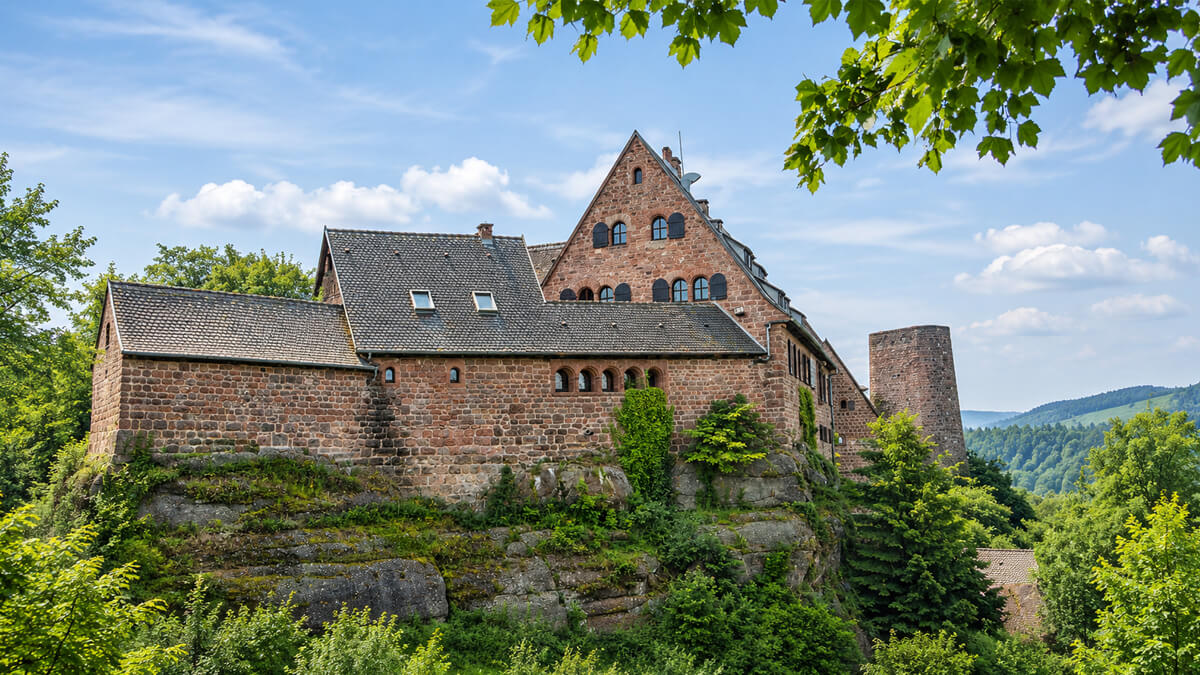
Hunebourg Castle (Château de Hunebourg, also called Château du Hunebourg) stands on a sandstone rock at an altitude of 425 m, above the valley of the Southern Zinsel, north-west of Dossenheim-sur-Zinsel. What you see today is not a medieval castle: the fortress of the Counts of Hunebourg was razed in the early 19th century, and the current buildings, with their neo-Romanesque tower, date from 1934 to 1941.
The site is private property. Having been a mutual society’s holiday home and then a hotel until 2018, it has returned to private use and no visits are offered. This page tells its story, one of the most unusual in the Northern Vosges, and what you can glimpse of it from outside.
At a glance
- Where: Dossenheim-sur-Zinsel (Bas-Rhin), west of Neuwiller-lès-Saverne, in the Northern Vosges
- Altitude: 425 m, on a sandstone rock
- Visits: none: private property, seen from outside only
- What remains: almost nothing of the medieval castle, apart from the rock-cut features and a cistern; a neo-Romanesque complex from 1934–1941 with a gatehouse and the Peace Tower
- Access: on the route of stage 8 of the Alsace Castles Trail, from La Petite-Pierre to Ernolsheim-lès-Saverne
- Who it’s for: 20th-century history enthusiasts and hikers on the Castles Trail
- Status: registered as a historic monument on 22 June 2007, owned by a private company
- Opening hours
- Private property: no visits and no opening hours announced
- Location
- Hunebourg rock, forest road north-west of Dossenheim-sur-Zinsel, west of Neuwiller-lès-Saverne (private property), Dossenheim-sur-Zinsel
- Price
- Not applicable (no visits)
- Getting there
- Viewable from outside only. The site lies on stage 8 of the Alsace Castles Trail (Chemin des châteaux forts d’Alsace, La Petite-Pierre – Ernolsheim-lès-Saverne), IGN map 3714 ET.
- Time needed
- Not applicable
- Accessibility
- Not applicable (private property)
Checked on October 26, 2026
Compare hotels for your dates before they fill up.
View on ExpediaPartner links.
Why is Hunebourg Castle worth knowing about?
- A castle rebuilt in the 20th century: a neo-Romanesque, regionalist complex from the 1930s, designed by the architect Karl Erich Loebell.
- A history spanning eight centuries: the Counts of Hunebourg, Marshal Clarke, Alsatian autonomism and the Second World War.
- A silhouette on a sandstone rock, on the route of the Alsace Castles Trail between La Petite-Pierre and Ernolsheim-lès-Saverne.
- A protected monument since 2007, from the Peace Tower to the “love grotto” created under Clarke and the estate’s boundary stones.
The history of Hunebourg Castle, from the counts to the 20th century
The history of the Hunebourg falls into three periods: a medieval castle shared between several families, a Romantic park under the Empire, then a highly political reconstruction between the wars.
- 1125 · a Count Folmar of Huneburc, linked to the Counts of Metz, is mentioned; a first castle is recorded.
- 1288 · first written mention of the castle: the Lichtenbergs agree with another family to defend it jointly.
- 1362 · Henry of Fleckenstein buys half of the castle; the Lichtenbergs grant the other half as a fief to Henry of Meckingen.
- 1378 · the castle is destroyed by the people of Strasbourg, then rebuilt.
- Second half of the 15th century · shared between several families (Weitenmühlen, Schoub, Krantz of Geispolsheim), it is gradually abandoned.
- 1809 · sold as national property, the site is bought by General Henri-Jacques-Guillaume Clarke, Minister of War, whom Napoleon makes Count of Hunebourg. He has the medieval keep demolished and lays out a park with a hunting lodge and a love grotto.
- 1932 · the Alsatian autonomist Friedrich (Fritz) Spieser buys the ruins to turn them into a family home and a guest house.
- 1934–1938 · the neo-Romanesque buildings are constructed to plans by Karl Erich Loebell; the Peace Tower is built in 1937–1938.
- 1939–1942 · Spieser leaves for Germany in 1939 and returns after 1940; during the annexation, the castle becomes a place of collaboration with the Nazi regime. The guest house, begun in 1939, remains unfinished.
- 1944–1949 · the estate is sequestrated, then bought at auction on 19 May 1949 by the Société mutualiste de l’Enregistrement, a mutual society that turns it into a holiday home.
- 2007 · registered as a historic monument on 22 June.
- 2018 · the hotel closes: the castle returns to private use.
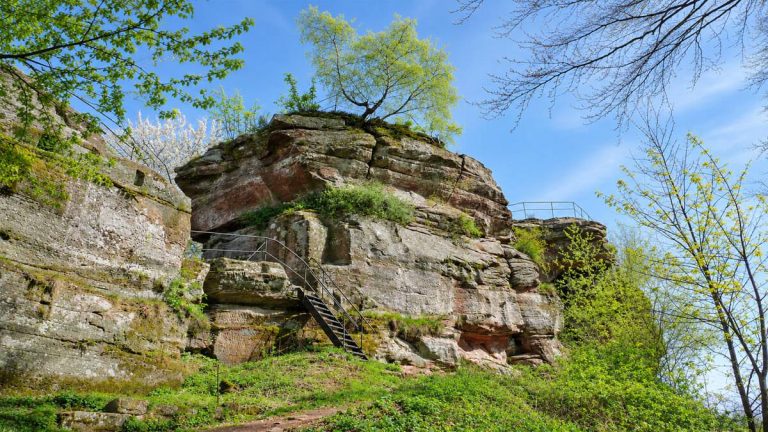
The site consists of two rocks. The “old castle” occupied the small rock, reached by a narrow staircase cut into the stone on the side opposite the bridge; the “new castle” covered the large rock. Spieser’s plans were far bigger than what was actually built: a great hall with a chapel and music room, a belvedere pavilion at the eastern tip of the rock, and a farm. The war put a stop to them.
The Peace Tower (Friedensturm) was dedicated to the soldiers from Alsace and Moselle who died in the First World War, presented as having fallen for Germany. In 1941, the remains of the autonomist Karl Roos were buried there; at the Liberation, his sarcophagus was thrown into the ditch.
 via GetYourGuideGuided tours in Dossenheim-sur-ZinselPrices and dates on the partner siteBook
 via GetYourGuideDay trips from Dossenheim-sur-ZinselPrices and dates on the partner siteBook
Partner links: if you book through these links, Alsace Voyage earns a commission at no extra cost to you.
What can you see of Hunebourg Castle?
As the castle is private, what follows describes the protected complex as documented by the sources; from outside, you can only make out its silhouette and façades, without entering the property.
The Peace Tower
The 1937–1938 neo-Romanesque keep is the most visible feature of the site. It was built on the site of the old castle, on the small rock.
The 1930s buildings
Spieser’s house, the hikers’ lodge, the servants’ house with its gatehouse and a small guest house have formed a neo-Romanesque, regionalist complex since 1935–1937. The large guest house, planned to be 34 m long and three storeys high, was only partly built in 1942.
Traces of the medieval castle
Almost nothing remains of the medieval walls. The 2007 protection does, however, cover the platform, the well, the filtration cistern on the large rock and the features cut into the small and large rocks.
The love grotto
Below the castle, this grotto created in Marshal Clarke’s park in the early 19th century is part of the registered monument, as are the boundary stones marking out the estate.
 Read nextFroensbourg Castle
How can you see Hunebourg Castle?
No visits are offered and no opening hours are published: you do not enter the property.
From the Zinsel valley
The rock is reached by a forest road from the valley of the Southern Zinsel, north-west of Dossenheim-sur-Zinsel. No visitor car park is indicated: park only in authorised spaces, without blocking access.
On foot along the Castles Trail
The Hunebourg is on stage 8 of the Alsace Castles Trail, which links La Petite-Pierre with Ernolsheim-lès-Saverne. Take IGN map 3714 ET with you.
Our tips
- Respect the private property: don’t climb over fences or enter the buildings.
- To visit a Northern Vosges castle with a welcome desk and exhibition, choose Lichtenberg; for a freely accessible stronghold, La Petite-Pierre.
- On the Castles Trail, bring good shoes, water and IGN map 3714 ET.
Top tip Make the Hunebourg one stop on a day out in the Northern Vosges: the fortified town of La Petite-Pierre in the morning, a look at the Hunebourg’s silhouette on the way, then the abbey church of Neuwiller-lès-Saverne in the afternoon.
What to do around Hunebourg Castle
The Hunebourg pairs well with the towns and castles of Alsace in the north of the Bas-Rhin, in the Northern Vosges Regional Nature Park.
Our picks around the Hunebourg
- Neuwiller-lès-Saverne · an abbey village east of the Hunebourg, known for the tapestries of St Adelphus.
- The fortified refuge of Dossenheim-sur-Zinsel · in the neighbouring village, in the castle’s municipality.
- La Petite-Pierre Castle · headquarters of the Regional Nature Park, with its fortified old town, ramparts and cisterns, freely accessible.
- Lichtenberg Castle · a restored fortress open to visitors, with an exhibition, cafeteria and events.
- Haut-Barr Castle · above Saverne, a lookout over the Alsace plain.
Our verdict
The Hunebourg is not a place to visit: it is a silhouette to spot and a story to know. Its interest lies less in its stones than in what it tells about 20th-century Alsace, between autonomism, annexation and the post-war period.
We recommend it to hikers on the Castles Trail and history buffs, provided they respect the private property. For a real castle visit in the area, Lichtenberg and La Petite-Pierre are the places to go.
— The Alsace Voyage team
Frequently asked questions about Hunebourg Castle
Can you visit Hunebourg Castle?
No. The castle is private property and no visits are offered. You can see it from outside, especially from the Alsace Castles Trail.
Is Hunebourg Castle still a hotel?
No. After being a mutual society’s holiday home and then a hotel, it ceased trading in 2018 and is now used privately.
How old is the current castle?
The current buildings were constructed between 1934 and 1941 in neo-Romanesque style, to plans by the architect Karl Erich Loebell. The medieval castle had been razed in the early 19th century.
Where is Hunebourg Castle?
On a sandstone rock at an altitude of 425 m, in the municipality of Dossenheim-sur-Zinsel, west of Neuwiller-lès-Saverne, in the Bas-Rhin.
Who was Clarke, Count of Hunebourg?
Henri-Jacques-Guillaume Clarke, a general and Napoleon’s Minister of War from 1807 to 1814, bought the ruins in 1809. He was made Count of Hunebourg, then Duke of Feltre.
Which castles can you visit near the Hunebourg?
Lichtenberg Castle, open to visitors with an exhibition and events, La Petite-Pierre Castle and its freely accessible ramparts, and the Haut-Barr above Saverne.
Sources: Base Mérimée (French Ministry of Culture) – Châteaux forts d’Alsace – Wikipedia (Château de Hunebourg, Hüneburg)
Hello ! My name is Clémence, and I’m a true lover of Alsatian culture and its ancestral traditions. Ever since my childhood spent strolling through Christmas markets and decorating bredeles, I’ve been fascinated by the authenticity of our beautiful region. Today, I share my passion for traditional costumes, local festivals, and Alsatian legends through my articles. What do I love most? Meeting artisans, tasting a new kougelhopf recipe, or discovering a forgotten little chapel. I hope my stories inspire you to dive into the festive and warm soul of Alsace.
 CastlesHohenbourg Castle