Contents · 7 sections
- Why visit Lichtenberg Castle?
- The history of Lichtenberg Castle, from the lords of Lichtenberg to 1870
- What to see at Lichtenberg Castle
- How to get to Lichtenberg Castle
- Our walk: from the village to the castle, then the chestnut trail
- Things to do around Lichtenberg Castle
- Frequently asked questions about Lichtenberg Castle
Lichtenberg Castle towers over the village of the same name, on the edge of the Northern Vosges. Built in the 13th century, turned into a fortress at the end of the 16th century and burned in 1870, it now brings together medieval towers, a Renaissance chapel, artillery works and contemporary additions by the architect Andrea Bruno.
Unlike many ruins in the Northern Vosges, it offers a visitor reception, a permanent exhibition, a cafeteria and events throughout the season. Parking is free in the centre of the village of Lichtenberg, a quarter of an hour’s walk away.
Key facts at a glance
- Where: Lichtenberg (Bas-Rhin), in the Northern Vosges Regional Nature Park, 30 km from Saverne and Haguenau, 60 km from Strasbourg
- Setting: on a sandstone hill overlooking the village
- Access: a 15-minute walk from the free car park on Place de l’Église
- Prices: adults €9, ages 4–17 €7, family (2 adults + 2 children) €28, free under 4 (2026 prices)
- Open: 3 April to 1 November 2026, Tuesday to Sunday; daily in July and August and during the Halloween holidays
- Time needed: about 1 hour 30 minutes
- Who it’s for: families (treasure trail for children), architecture lovers; dogs allowed on a lead
- Status: historic monument listed in 1878, owned by the municipality, “Architecture contemporaine remarquable” label
- Opening hours
- 2026 season: from 3 April, Tuesday to Sunday and public holidays, 10 am–5 pm; May–June Tuesday to Sunday 10 am–6 pm; July–August daily 10 am–6 pm; September to 11 October Tuesday to Sunday 10 am–5 pm; closed 12 to 16 October; 17 October to 1 November (Halloween) daily 12 noon–7 pm. Last admission 1 hour before closing.
- Location
- Château de Lichtenberg, 67340 Lichtenberg; free parking on Place de l’Église, in the village centre, Lichtenberg
- Price
- Adults €9; children aged 4 to 17, students, disabled visitors €7; family pass €23 (2 adults + 1 child), €28 (2 + 2), €32 (2 + 3); free under 4. Event days: €11 to €15 (adults), €8 to €10 (reduced). 2026 prices.
- Getting there
- Free parking on Place de l’Église, then a 15-minute walk along a safe footpath (suitable for pushchairs). Two disabled parking spaces near the entrance, via Rue des Cochers. By train: TER to Ingwiller, then TER bus on weekdays.
- Time needed
- About 1 hour 30 minutes for the visit, plus a 30-minute round-trip walk from the car park
- Accessibility
- Reception, ticket office, shop, cafeteria, exhibitions and auditorium accessible via walkways or a lifting platform; the outdoor route is not fully wheelchair accessible. Dogs allowed on a lead.
Checked on October 26, 2026
Compare hotels for your dates before they fill up.
View on ExpediaPartner links.
Why visit Lichtenberg Castle?
- Eight centuries of architecture on one rock: medieval towers, Renaissance chapel, 16th-century arsenal, artillery bastion and contemporary additions.
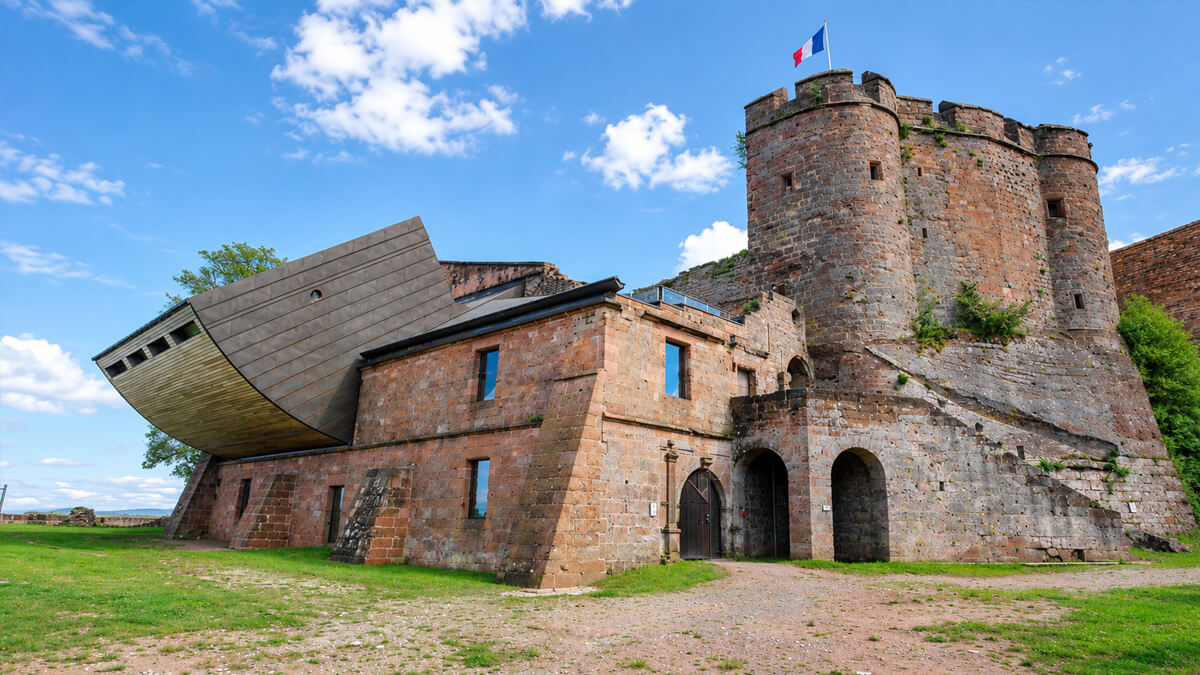
- A bold restoration: Andrea Bruno and Jean-Pierre Laubal inserted modern volumes into the ruins, such as the glued laminated timber hall in the Arsenal.
- Views over the Northern Vosges from the artillery terrace built in 1840.
- A visit designed for families: free map in three languages, €2 treasure trail for children, free Trésors d’Alsace app.
- A living castle: open-air theatre since 1913, the Médiévales medieval festival, Easter and Halloween events.
The history of Lichtenberg Castle, from the lords of Lichtenberg to 1870
The history of Lichtenberg follows that of a great noble family of Lower Alsace, then of the Counts of Hanau-Lichtenberg, before the fortress became a French stronghold for nearly two centuries.
- 1206 · first mention of the Lichtenberg family, vassals of the bishops of Metz.
- Early 13th century · a keep already dominates the site, probably built on land belonging to the abbey of Neuwiller-lès-Saverne.
- 1260 · the bishop of Metz destroys the first castle.
- 1286 · Conrad of Lichtenberg, bishop of Strasbourg, has the castle rebuilt and enlarged.
- 1480 · the Lichtenberg line dies out; the castle is shared between the Counts of Hanau and of Zweibrücken-Bitche.
- 1570 · Philip IV of Hanau-Lichtenberg reunites the inheritance and has the castle modernised.
- Late 16th century · the Strasbourg architect Daniel Specklin turns it into a fortress adapted to artillery, while keeping it as a residence.
- October 1678 · after an eight-day siege led by Marshal de Créquy, the stronghold surrenders and receives a French garrison for nearly two centuries.
- 9 August 1870 · the French garrison surrenders to Württemberg troops after three days of resistance; a fire ruins the fortress.
- 1878 · listed as a historic monument.
- 1913 · first open-air performances in the ruins, the origin of the Lichtenberg theatre.
- 1991–2015 · a European competition won by Andrea Bruno and Jean-Pierre Laubal, followed by restoration in four phases from 1995 to 2015.
The restoration did not try to rebuild the castle as it once was: the new sections stand out clearly from the old walls. This approach, debated at the time, earned the site the “Architecture contemporaine remarquable” label. The castle belongs to the municipality and is managed by the Communauté de communes de Hanau-La Petite Pierre.
At the end of the Second World War, during the bombing linked to Operation Nordwind, the villagers took refuge in the castle.
 via GetYourGuideGuided tours in LichtenbergPrices and dates on the partner siteBook
 via GetYourGuideDay trips from LichtenbergPrices and dates on the partner siteBook
Partner links: if you book through these links, Alsace Voyage earns a commission at no extra cost to you.
What to see at Lichtenberg Castle
A free map in French, German and English is handed out at reception. The permanent exhibition “Le château de Lichtenberg, un chantier perpétuel” (Lichtenberg Castle, a never-ending building site), opened in 2023, tells the story of its transformations with models, reconstructions and interactive displays.
The central rock and the medieval towers
Two western towers of the original castle survive, linked by a shield wall. One bears carved heads and is thought to have served as an oratory in the 15th century. Only the base of the keep remains, marked out on the ground.
The Renaissance chapel
Built at the end of the 16th century, it has a star-ribbed vault and a polygonal apse. It houses the Renaissance funerary monument of Philip V of Hanau-Lichtenberg and his wives; members of the family were laid to rest in the crypt.
The Arsenal and the Pavillon des Dames
Built by Specklin in the 16th century and reinforced with buttresses in 1749, the Arsenal now houses a glued laminated timber hall that can be seen from the village. The Pavillon des Dames (Ladies’ Pavilion) combines two 15th– and 16th-century houses with Renaissance decoration, converted between 2000 and 2002 to hold a documentation centre, an educational workshop and the cafeteria.
The artillery terrace, the cistern and the bastion
A spiral staircase from 1840 leads up to the artillery terrace, which looks out over the Northern Vosges. Further on: the cistern that collected rainwater, with a Gothic well curb, the pentagonal bastion pierced with gun ports, the casemates once used as a powder magazine, the dry moat and the covered way.
The legend of Count Louis of Lichtenberg
Local tradition remembers Count Louis of Lichtenberg, said to be the last of his line. He is described as something of a sorcerer but an honest man, quick to play tricks on rogues, such as a dishonest merchant. These tales belong to folklore and are not confirmed by historical sources.
The Lichtenberg sound walk (1.5 km, 45 minutes) shares other memories and legends of the village, told by its residents.
 Read nextFroensbourg Castle
How to get to Lichtenberg Castle
By car: Place de l’Église car park (15-minute walk)
Lichtenberg is about 50 minutes from Strasbourg (60 km) and 35 minutes from Saverne or Haguenau (30 km).
- Head to the centre of Lichtenberg and park for free on Place de l’Église (charging point for electric cars and e-bikes).
- Take the safe footpath that climbs to the castle; it was renovated in 2014.
- Allow about 15 minutes of gradual climb: the path is suitable for pushchairs.
For visitors with reduced mobility
Two reserved spaces are located near the entrance, via Rue des Cochers, 200 m uphill from reception. The indoor areas are accessible via walkways or a lifting platform, but not the whole outdoor route. An accessibility guide is available on the castle’s website.
Without a car
Take the TER Strasbourg–Sarreguemines train to Ingwiller station, then the TER bus to Lichtenberg. It only runs Monday to Friday, except public holidays and school holidays, with two or three return journeys a day: check the timetable before you set off. Keen walkers can also follow an 18.6 km loop (about 5 hours 30 minutes) from Ingwiller station, on Club vosgien trails along the Moder.
On foot along the Castles Trail
Lichtenberg is the end point of stage 6 of the Alsace Castles Trail (Chemin des châteaux forts d’Alsace), starting from Niederbronn-les-Bains. To plan the walk, also read our article on the GR53 stage from Niederbronn-les-Bains to Lichtenberg.
Our walk: from the village to the castle, then the chestnut trail
To round off the visit, add a waymarked loop around the village. Allow half a day in all, including the castle visit.
Start · Place de l’Église
Park for free in the village centre, next to the church.
Stage 2 · The footpath
A steady quarter-hour climb to the castle entrance, with no difficulty.
Stage 3 · The castle and its educational trail
After the visit (about 1 hour 30 minutes), walk around the fortifications on the educational trail, which is suitable for pushchairs and can be used even outside opening hours.
Finish · The Schaentzel plateau
The chestnut trail (4 km, 1 hour 30 minutes, blue ring around a chestnut) leads to this plateau: on a clear day you can make out the spire of Strasbourg Cathedral. The fountains trail (7 km, 2 hours, green ring) passes springs and old wash houses.
Our tips for your visit
- Check the calendar before you go: the castle is closed from 12 to 16 October 2026, and higher prices apply on event days.
- Wear walking shoes: the route includes stairs, slopes and uneven ground.
- Dogs are welcome on a lead.
- The cafeteria and shop are free to enter; last cafeteria orders 30 minutes before closing.
- With children, ask at reception for the treasure trail “À la recherche des sculptures de Johann” (In search of Johann’s sculptures, €2).
Money-saving tip Keep your ticket: it entitles you to the reduced rate at Haut-Kœnigsbourg and Fleckenstein, and vice versa (except during events). The Pass Alsace and the Museum-Pass-Musées are also accepted outside events.
Things to do around Lichtenberg Castle
Lichtenberg combines well with the small towns of the Hanau area, the nature of the Northern Vosges Regional Nature Park and other castles of Alsace.
Our picks around Lichtenberg
- La Petite-Pierre · a fortified town perched on a sandstone spur, headquarters of the Northern Vosges Regional Nature Park.
- Bouxwiller · former residence of the Counts of Hanau-Lichtenberg, awarded the Petite Cité de Caractère label.
- The Lalique Museum · in Wingen-sur-Moder, devoted to the art of glass and crystal.
- The rock houses of Graufthal · troglodyte dwellings carved into the sandstone, in the municipality of Eschbourg.
- The abbey church of Neuwiller-lès-Saverne · known for its tapestries of Saint Adelphus.
Our editors’ verdict
Lichtenberg is the castle to choose for a family outing in the Northern Vosges: the walk is short, the visit is well organised and children find plenty to keep them busy. Architecture lovers will see it above all as a rare experience: an old fortress restored without pastiche.
Those looking for wild ruins in the forest may be surprised by the contemporary additions, but they tell the castle’s story as much as its old walls do. We recommend it in spring and September, away from the big event weekends, when the artillery terrace is quiet.
— The Alsace Voyage editorial team
Frequently asked questions about Lichtenberg Castle
How much does it cost to visit Lichtenberg Castle?
€9 for adults and €7 for ages 4–17, students and disabled visitors (2026 prices). The family pass for 2 adults + 2 children costs €28 and admission is free under 4. On event days, expect €11 to €15 per adult.
When is Lichtenberg Castle open?
In 2026, the season runs from 3 April to 1 November: Tuesday to Sunday, and daily in July and August and during the Halloween holidays. The castle is closed from 12 to 16 October; last admission one hour before closing.
Where to park for Lichtenberg Castle?
In the free car park on Place de l’Église, in the village centre. A safe footpath leads to the castle in about 15 minutes.
How long does the visit take?
Allow about 1 hour 30 minutes on site, plus a half-hour round-trip walk from the car park.
Are dogs allowed at Lichtenberg Castle?
Yes, dogs are allowed on a lead.
Is the castle wheelchair accessible?
Partly: two reserved spaces are located near the entrance and the indoor areas are accessible via walkways or a lifting platform, but not the whole outdoor route.
Which castles can you see near Lichtenberg?
The castle of La Petite-Pierre, headquarters of the Northern Vosges Regional Nature Park, and Fleckenstein, which offers a reduced rate on presentation of a Lichtenberg ticket. Hunebourg, above Dossenheim-sur-Zinsel, is privately owned and can only be seen from outside.
Sources: Château de Lichtenberg (official website) – Office de tourisme de Hanau-La Petite Pierre – Base Mérimée (French Ministry of Culture) – Châteaux forts d’Alsace – Wikipedia (Lichtenberg Castle)
Hello ! My name is Clémence, and I’m a true lover of Alsatian culture and its ancestral traditions. Ever since my childhood spent strolling through Christmas markets and decorating bredeles, I’ve been fascinated by the authenticity of our beautiful region. Today, I share my passion for traditional costumes, local festivals, and Alsatian legends through my articles. What do I love most? Meeting artisans, tasting a new kougelhopf recipe, or discovering a forgotten little chapel. I hope my stories inspire you to dive into the festive and warm soul of Alsace.
 CastlesHohenbourg Castle