Contents · 7 sections
- Why visit Warthenberg Castle?
- The history of Warthenberg Castle, from the 12th century to the excavations
- What to see at Warthenberg Castle
- How to get to Warthenberg Castle
- Our walks: the short and long Daubenschlag loops
- Things to do around Warthenberg Castle
- Frequently asked questions about Warthenberg Castle
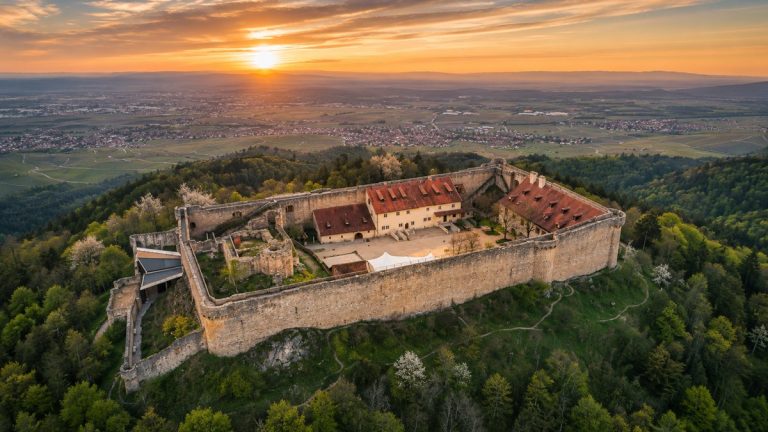
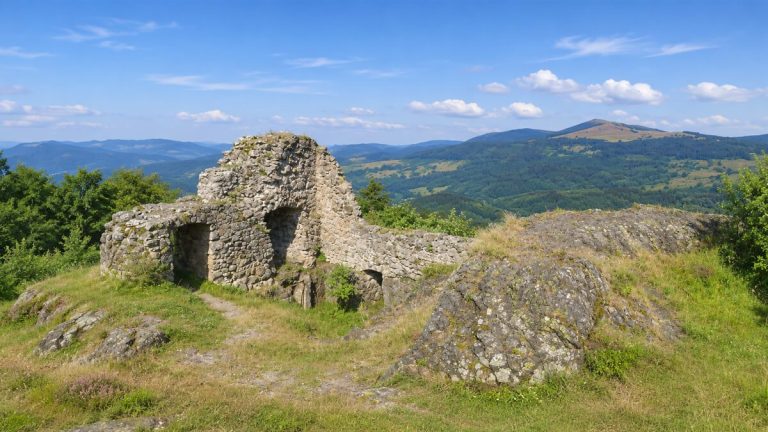
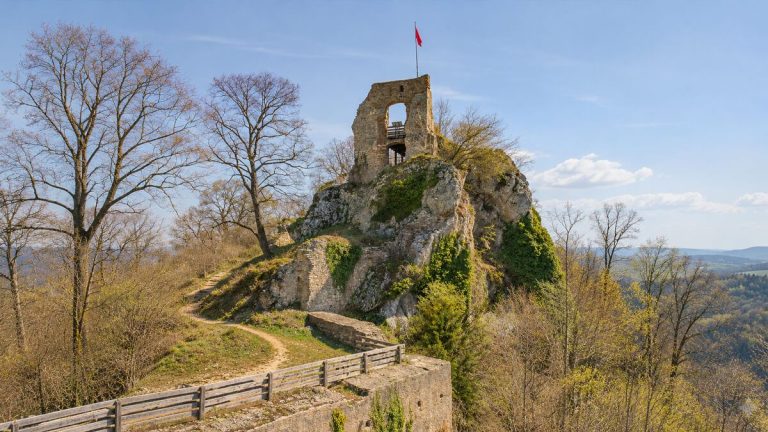
Warthenberg Castle lay hidden underground for a long time. Its remains crown the Daubenschlag rock, at an altitude of 402 m, where the Zinsel valley opens onto the plain, above Ernolsheim-lès-Saverne. Built in the mid-12th century and ruined before 1200, it was only identified after excavations began in 1979.
It is therefore an “archaeological” castle: no standing towers, but cleared and consolidated walls that reveal the layout of a Romanesque fortress, with a 3.80 m-thick shield wall and one of the largest keeps in Alsace. The site is free and open to all, a twenty-minute walk from the village.
Key facts at a glance
- Where: Ernolsheim-lès-Saverne (Bas-Rhin), about 8 km north of Saverne, in the Northern Vosges Regional Nature Park
- Altitude: 402 m, on the Daubenschlag rock
- Access: 20 minutes on foot from the church in Ernolsheim (steep waymarked path), 45 minutes from the Croix de Langenthal car park
- Price: free, open access all year round
- Time needed: 1 hour 15 minutes to 1 hour 30 minutes from Ernolsheim, including the visit
- Who it’s for: families with children who enjoy walking, hikers, archaeology enthusiasts
- Status: registered as a historic monument on 16 December 1994, owned by the municipality of Ernolsheim-lès-Saverne
- Opening hours
- Open access all year round, in daylight (forest site, unstaffed)
- Location
- Daubenschlag rock (Daubenschlagfelsen), above Ernolsheim-lès-Saverne; start on foot near the village church or town hall, Ernolsheim-lès-Saverne
- Price
- Free, open access
- Getting there
- No car access. About 20 minutes on foot up a steep waymarked path from the church in Ernolsheim-lès-Saverne; about 45 minutes from the Croix de Langenthal car park (blue rectangle of the Club vosgien); you can also start from the campsite in Dossenheim-sur-Zinsel.
- Time needed
- 1 hour 15 minutes to 1 hour 30 minutes from Ernolsheim, including the climb and the visit
- Accessibility
- Steep path and rocks: not suitable for wheelchairs or pushchairs
Checked on October 26, 2026
Compare hotels for your dates before they fill up.
View on ExpediaPartner links.
Why visit Warthenberg Castle?
- A Romanesque castle in its original state: occupied only briefly, it was not altered in later centuries, making it a rare example of 12th-century architecture.
- An exceptional shield wall: 3.80 m thick, perhaps the oldest in Alsace.
- A large keep: 11 m per side, the third largest in Alsace by footprint according to the tourist office, after Greifenstein and Lutzelbourg.
- A short walk: a twenty-minute climb from the village, or a gentler stroll from the Croix de Langenthal.
- A free outing, on the stage of the Alsace Castles Trail that comes from La Petite-Pierre.
The history of Warthenberg Castle, from the 12th century to the excavations
The history of Warthenberg rests on very few texts: a charter from 1158, an attempt at rebuilding a century later, then oblivion. It was the excavations that made it possible to link the ruins on the Daubenschlag to this name.
- Mid-12th century · construction of the castle, attributed to Hugh of Dabo, of the Eguisheim-Dabo family, Count of Metz and advocate of Neuwiller Abbey.
- 1158 · Warthenberg is mentioned in a charter of Neuwiller Abbey: this is the only written record of the fortress while it was in use.
- Before 1200 · the castle is destroyed after a short period of occupation; according to some sources, it was never even completed.
- 1260 · the lords of Lichtenberg set out to rebuild it, but give up the following year under pressure from the bishop of Metz.
- Around 1515 · the ruins serve as a quarry: stones are taken for a bridge over the Zinsel at Dossenheim, prompting complaints from the Count of Hanau-Lichtenberg.
- 1979 · volunteers from the Centre de recherches archéologiques médiévales de Saverne (CRAMS) begin clearing the site.
- 1981–1992 · excavation campaigns uncover the moat, shield wall, keep, living quarters, chapel and cisterns.
- 1986 · the Ernolsheim branch of the Club vosgien builds a shelter at the north-eastern end of the ridge.
- 1994 · the remains are registered as a historic monument.
The castle’s rusticated stones come from a 12th-century quarry about 2 km away. Among the finds are horns used for signalling. Today the site is maintained by the Pro Daubenschlag association.
The rock is also linked to an old tradition of the people of Ernolsheim, the Dùweschlawe: glowing discs were hurled at night, a custom that the Châteaux forts d’Alsace website traces back to Celtic times.
 via GetYourGuideGuided tours in Ernolsheim-lès-SavernePrices and dates on the partner siteBook
 via GetYourGuideDay trips from Ernolsheim-lès-SavernePrices and dates on the partner siteBook
Partner links: if you book through these links, Alsace Voyage earns a commission at no extra cost to you.
What to see at Warthenberg Castle
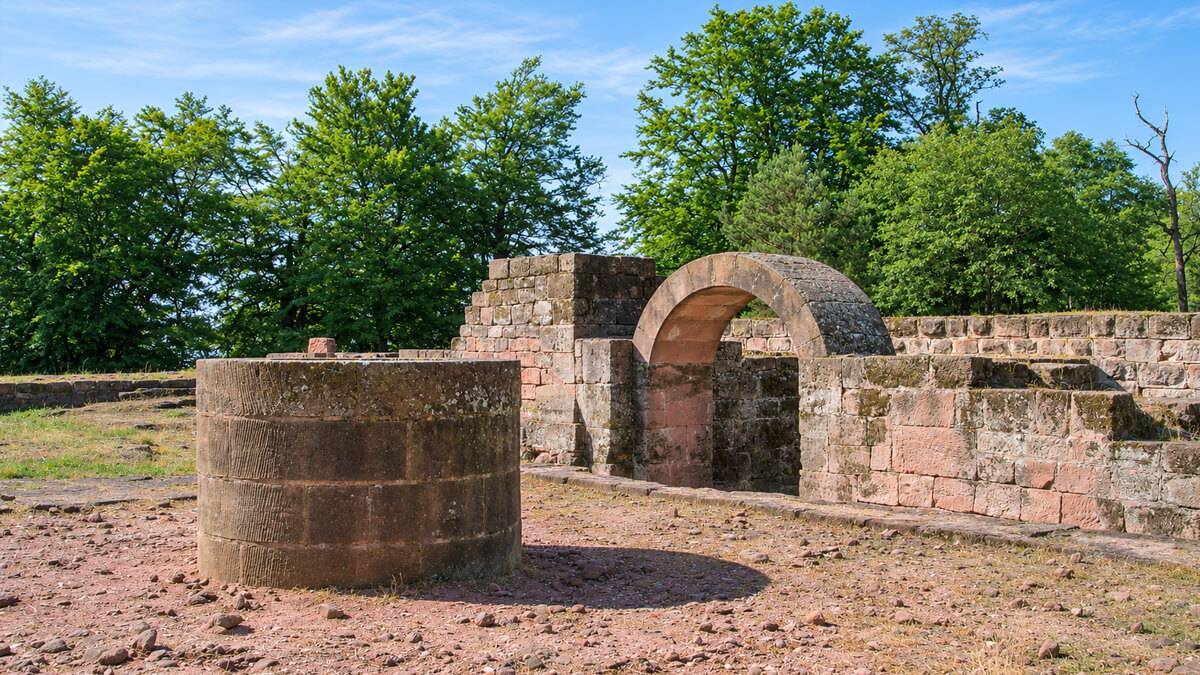
The remains stretch about 200 m long and up to 50 m wide, following the ridge. The walls are low: it is the floor plan you read rather than the elevation.
The moat and the shield wall
On the mountain side, a moat 12 m wide and up to 4.50 m deep to the east cuts across the ridge; it was never finished. Behind it rises the 3.80 m-thick shield wall, which protected the whole castle on its most exposed side.
The keep
Square, 11 m per side, with walls 3 m thick, it stands against the shield wall. It survives to a height of about 2.20 m. To the east lie the foundations of a residential building.
The cross wall and the palace
Some fifty metres to the north, a wall 2.80 m thick blocks the full width of the site. Against its north face stood the palace, the lord’s great hall, where excavations unearthed many finely worked architectural pieces.
The chapel and the cisterns
Along the eastern cliff, faint traces of a chapel can be made out. Two filtration cisterns, one near the keep and the other near the palace, collected rainwater and purified it through sand.
 Read nextWasigenstein Castle
How to get to Warthenberg Castle
No road leads up to the castle. There are three possible starting points on foot, all waymarked by the Club vosgien; IGN map 3715 OT covers the area.
From Ernolsheim-lès-Saverne (20 minutes, steep)
This is the shortest route: a steep waymarked path starts from the village church, near the town hall, and climbs straight up to the rock.
- Head to Ernolsheim-lès-Saverne, north of Saverne, and park near the town hall.
- Walk to the church and take the waymarked path that climbs towards the Daubenschlag.
- After about twenty minutes of steady climbing, you reach the castle.
From the Croix de Langenthal car park (45 minutes, gentle slope)
Above Saint-Jean-Saverne, the Croix de Langenthal car park is the starting point of the Club vosgien’s blue rectangle trail, which runs towards Dossenheim-sur-Zinsel via the castle. The gradient is more even; allow about 45 minutes’ walk.
From Dossenheim-sur-Zinsel
You can also start from the campsite car park in Dossenheim-sur-Zinsel: follow the old road to the Club vosgien waymarks at the entrance to the Zinsel valley, then climb up to the rock.
Our walks: the short and long Daubenschlag loops
The Châteaux forts d’Alsace walking guide suggests two loops: a short 5 km one from Ernolsheim, and a longer 10 km one from the Croix de Langenthal. Here are the main stages of the short loop.
Start · Ernolsheim-lès-Saverne
Park near the town hall and walk to the church, at the foot of the hill.
Stage 2 · The steep Daubenschlag path
The waymarked path climbs steeply through the forest: twenty minutes of effort, with no technical difficulty.
Stage 3 · Warthenberg Castle
Cross the moat, walk along the shield wall and the keep, then follow the ridge to the cross wall and the palace. The Club vosgien shelter is at the north-eastern end.
Finish · Back to the village
Go back down the same way, or complete the 5 km route from the walking guide to return to Ernolsheim.
Our tips for your visit
- Wear good shoes: the steep path from Ernolsheim is sloping and slippery after rain.
- Bring water: there is no water point and no toilets on site.
- The ruins are fragile: do not climb on the walls or move stones, and keep away from the drops.
- Keep children close to you along the cliffs of the ridge.
- Dogs are allowed.
Top tip To make sense of what you see, walk up via the Croix de Langenthal and down to Ernolsheim: the gentle slope on the way up leaves you breath for the visit, and you take the steep path in the right direction. You will then need to arrange to get back to your car, or do the return trip from the village.
Things to do around Warthenberg Castle
Warthenberg sits at the junction between the Northern Vosges and the Saverne area. It combines well with other castles of Alsace and with the foothill villages.
Our picks around Warthenberg
- Ernolsheim-lès-Saverne · the village at the foot of the rock, starting point of the shortest route.
- Neuwiller-lès-Saverne · home of the abbey to which Warthenberg belonged, mentioned in its 1158 charter.
- Hunebourg Castle · to the north, near Dossenheim-sur-Zinsel: a medieval castle rebuilt in neo-Romanesque style between 1934 and 1941, privately owned and visible from outside.
- Haut-Barr Castle · the “eye of Alsace”, on its three rocks above Saverne, with a car park at the foot.
- Greifenstein Castle · west of Saverne, the largest Romanesque keep in Alsace, well worth comparing with Warthenberg’s.
Our editors’ verdict
Warthenberg lacks the spectacular silhouette of the great Vosges ruins, and you should know this before climbing up: here, you read a plan on the ground. But that is exactly what makes it precious. Abandoned before the end of the 12th century, it shows a Romanesque castle as it was designed, without the additions of later centuries.
We recommend it to archaeology enthusiasts and families looking for a short outing, in spring or autumn, when the vegetation leaves the walls visible. To grasp the scale of its 11 m keep, go and see the one at Greifenstein afterwards, from the same period and still standing.
— The Alsace Voyage editorial team
Frequently asked questions about Warthenberg Castle
Is there an entrance fee for Warthenberg Castle?
No. The site is free and open to the public all year round. It is unstaffed: visit in daylight and treat the remains with care.
How long does it take to climb up to Warthenberg?
About 20 minutes via the steep waymarked path from the church in Ernolsheim-lès-Saverne, or 45 minutes on a gentle slope from the Croix de Langenthal car park.
Can you drive there?
No. No road leads up to the Daubenschlag rock: park in Ernolsheim-lès-Saverne, at the Croix de Langenthal or at the campsite in Dossenheim-sur-Zinsel.
What remains of the castle?
Walls uncovered by the excavations: the moat, the 3.80 m shield wall, the 11 m-square keep preserved to about 2 m, the foundations of the living quarters and the palace, a chapel and two cisterns.
Are Warthenberg and Daubenschlag the same castle?
Yes. The Daubenschlag is the rock, Warthenberg the castle on top of it. The two names are often used together, for example in the Mérimée database.
Are dogs allowed?
Yes, dogs are allowed on the site. Keep them close to you because of the cliffs.
Sources: Châteaux forts d’Alsace – Office de tourisme du Pays de Saverne – Base Mérimée (French Ministry of Culture) – Wikipedia (Château du Warthenberg)
Hello ! My name is Clémence, and I’m a true lover of Alsatian culture and its ancestral traditions. Ever since my childhood spent strolling through Christmas markets and decorating bredeles, I’ve been fascinated by the authenticity of our beautiful region. Today, I share my passion for traditional costumes, local festivals, and Alsatian legends through my articles. What do I love most? Meeting artisans, tasting a new kougelhopf recipe, or discovering a forgotten little chapel. I hope my stories inspire you to dive into the festive and warm soul of Alsace.
 CastlesFerrette Castle