Contents · 7 sections
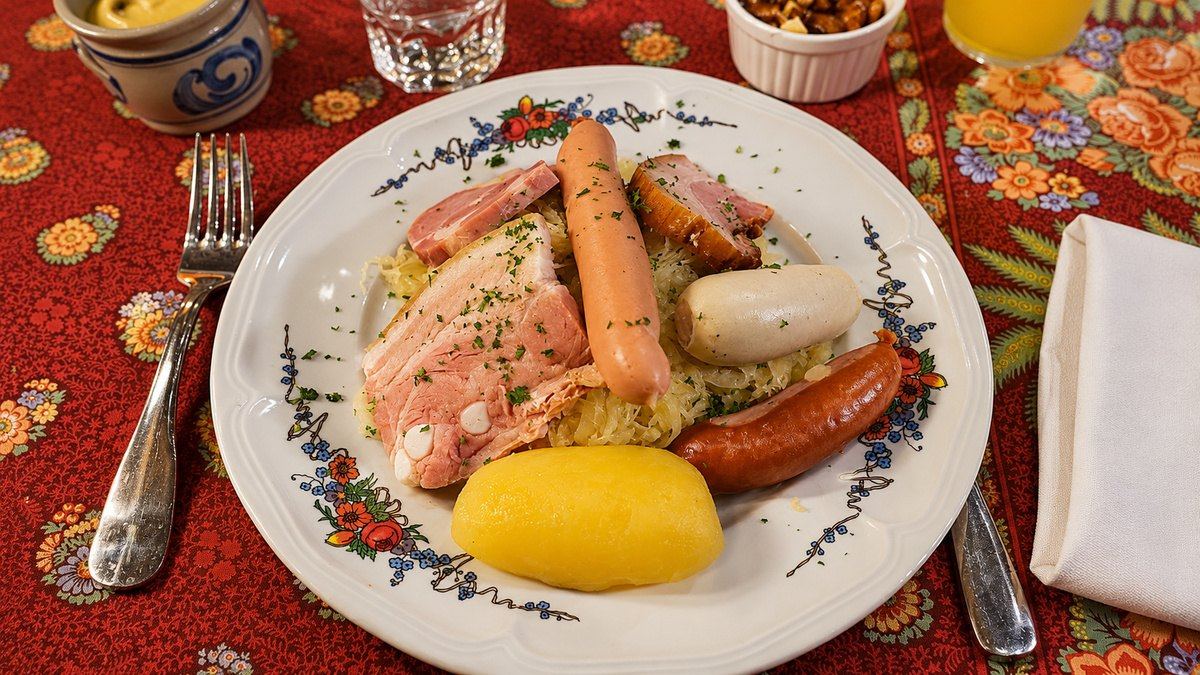
Choucroute garnie is probably the most famous of all Alsatian specialities. In Alsatian it is called sûrkrût (literally “sour cabbage”): finely shredded white cabbage, salted and then fermented for several weeks, a preserving technique used for centuries to keep vegetables through the winter. Slowly simmered in white wine with juniper berries, then topped with smoked pork and sausages, it becomes a hearty, generous one-pot meal, ideal from autumn to spring.
At a glance
Where to stay in Alsace
Compare hotels for your dates before they fill up.
View on ExpediaPartner links.
Time and difficulty
- Preparation: 30 minutes
- Cooking: about 2 hours
- Difficulty: easy
- Serves 6
Ingredients for 6 people
For the sauerkraut
- 1.5 kg raw sauerkraut (preferably Alsatian sauerkraut, from a pork butcher or the market)
- 1 large onion
- 2 tablespoons lard or goose fat
- 300 ml dry Alsace white wine (Riesling or Sylvaner)
- 200 ml water or stock
- 10 juniper berries
- 1 bay leaf
- 2 cloves
- Pepper (no salt needed: the sauerkraut and the cured meats provide enough)
For the garnish
- 1 smoked pork shoulder or smoked pork loin (about 800 g)
- 400 g smoked bacon in one piece
- 6 Strasbourg sausages (knacks)
- 6 smoked cooking sausages (such as Montbéliard sausage or Alsatian smoked sausage)
- 12 small waxy potatoes
Book an activity in Alsace
All activities via GetYourGuideGuided tours in AlsacePrices and dates on the partner siteBook
 via GetYourGuideDay trips from StrasbourgPrices and dates on the partner siteBook
Partner links: if you book through these links, Alsace Voyage earns a commission at no extra cost to you.
Method
- Taste the raw sauerkraut: if it is very sour, rinse it quickly in cold water, then squeeze it firmly between your hands. Tease it apart with a fork to loosen it.
- Peel and slice the onion. In a large cast-iron casserole, soften it gently for 5 minutes in the lard or goose fat, without letting it colour.
- Add half the sauerkraut, the juniper berries, the bay leaf and the cloves (enclosed in a tea infuser or a muslin bag so they are easy to remove), then the rest of the sauerkraut.
- Pour in the white wine and water, and season with pepper. Bury the pork shoulder (or loin) and the smoked bacon in the middle of the sauerkraut. Cover and leave to simmer over a low heat for 1 hour 30 minutes, adding a little liquid if necessary: the sauerkraut should stay moist, never dry.
- Meanwhile, peel the potatoes. Place them on top of the sauerkraut (or steam them separately) and add the smoked sausages for the last 30 minutes of cooking.
- Ten minutes before serving, poach the Strasbourg sausages in a pan of barely simmering water, never letting it boil, or they will burst.
- Remove the spices and slice the pork shoulder and bacon. Arrange the sauerkraut on a large warmed platter and lay the meats, sausages and potatoes on top. Serve with mustard and, if you like, horseradish.
 Read nextMannele (Mannala) recipe: Alsace’s Saint Nicholas brioche
Origins and tradition
Choucroute is the winter dish par excellence: the cabbage is harvested in autumn, then left to ferment in brine. The Alsace plain, especially around Krautergersheim, south-west of Strasbourg, is renowned for growing sauerkraut cabbage, and “Choucroute d’Alsace” now has protected geographical indication (PGI) status. Every family has its own garnish: some add pork knuckle (wädele), black pudding, liver dumplings (lewerknepfle) or a piece of smoked pork collar.
Possible variations
- Fish choucroute: a modern variation with salmon, haddock and cod and a beurre blanc sauce.
- Crémant choucroute: replace the still wine with Crémant d’Alsace for a more delicate note.
- Farmhouse version: add a grated tart apple or a few carrots at the start of cooking to soften the acidity.
The chef’s tips
- Choucroute is even better reheated: make it the day before and warm it up gently with a little wine.
- Never add salt: the smoked meats release enough salt during cooking.
- Buy raw rather than pre-cooked sauerkraut: you will have control over the cooking and seasoning.
Which wine to serve with choucroute?
Serve the same wine you cooked with: a dry Alsace white wine such as Riesling, whose acidity matches that of the cabbage, or a Sylvaner, simpler and more thirst-quenching. A Pinot Blanc also works very well. Avoid wines that are too aromatic or sweet, as they clash with the acidity of the dish. A blond Alsatian beer is the other traditional accompaniment.
Have you made this recipe? Rate it
Be one of the first to rate it.
Lucas
Hi, I’m Lucas! My heart beats for the pleasures of the table, and here in Alsace, I’m in paradise. Whether it’s a glass of Riesling shared with friends, a hearty sauerkraut dish, or a culinary adventure around a blueberry tart, I live every meal like a celebration. My goal? To make you hungry with articles that highlight our local producers, talented chefs, and delicious specialties. But beware, I don’t just eat (well, almost): I also offer itineraries to explore our vineyards and gourmet markets.
 Alsatian RecipesLammele: the recipe for the Alsatian Easter lamb cake